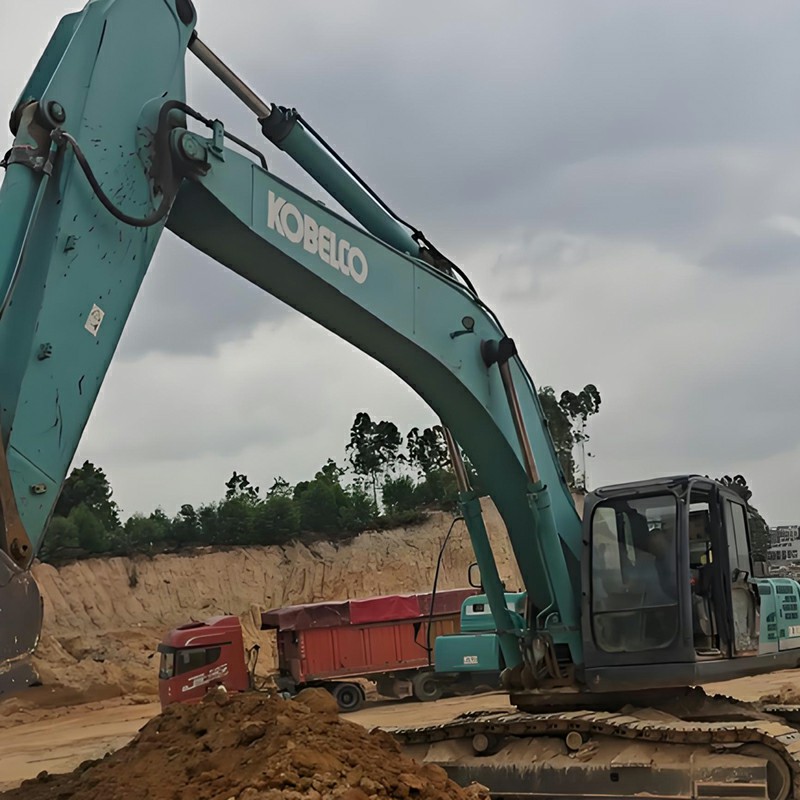
FIELD NOTES / SK200-8 & J05E-TA / SOLENOID BANK & HYDRAULIC OIL
When boom, arm, bucket, swing and travel all become slow at the same time, the fault is almost never inside one of those circuits. It sits in something every function shares: pilot oil supply, pump control, the solenoid manifold, or the oil that feeds all of them. A healthy engine with five equally sluggish movements is a shared-cause symptom, and treating it as a worn-out main pump is the most expensive mistake in this category.
Here is the case this guide is built on. An SK200-8 arrived with every function slow. Several solenoid valves on the same eight-position bank were found sticking. Each one was removed, cleaned and refitted, and machine speed came back. Then the hydraulic tank was opened and the oil was found dark and heavily degraded. That second finding changes the whole job: cleaning the valves made the machine move again, but it did not remove what made the valves stick. Leave the contaminated oil in the system and the same valves will stick again.
This guide gives you the symptom split first, then the factory check sequence with its real pressure values, then the repair order that addresses both halves of the problem. It is written for a Kobelco SK200-8 with the Hino J05E-TA — see which machines this covers before applying the numbers to yours.
On this page
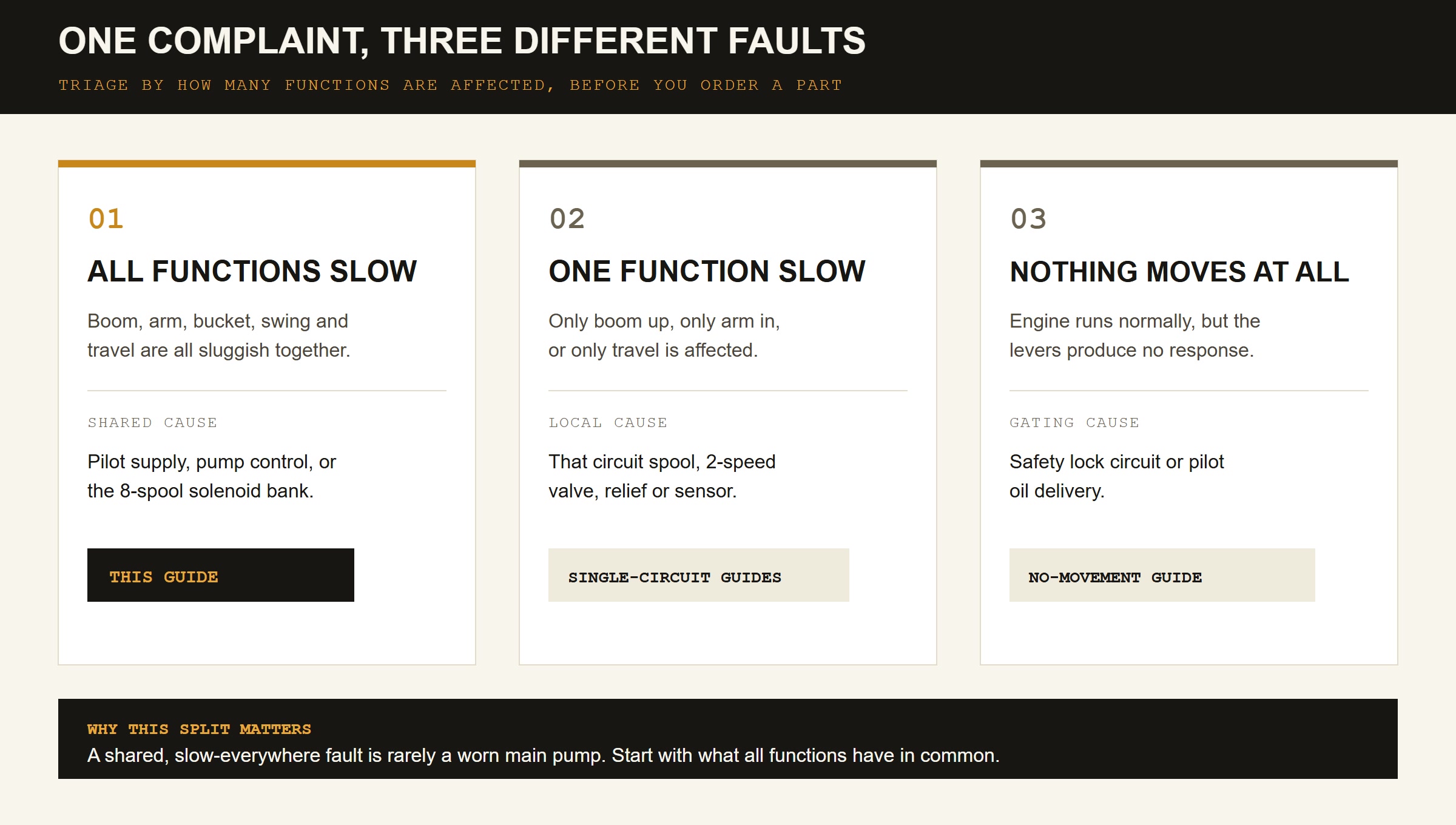
First, split the symptom: slow everywhere or just one function
Before any tools come out, answer one question: how many functions are affected?
The SK200-8 service manual organises chapter 47 by symptom, not by component, and lists 22 separate complaint groups. Four of them are commonly confused with each other:
(1) All operations inoperative / slow — the subject of this guide.
(5) Boom raise slow or weak — one circuit.
(7) Arm retract slow or weak — one circuit.
(15) Travel slow or weak — one circuit, or the travel system.
Note that the factory puts "no response at all" and "slow" into the same case (1) table. So the very first check is whether the machine moves at least a little. If it does not move at all, you are in a different branch — the safety lock and pilot supply checks in our no-instrument beep test guide and the instrument-based four-check guide. If only one movement is slow, use the circuit-specific guides instead.
| What the operator reports | Layer to investigate | Start here |
|---|---|---|
| Every movement is slow, engine sounds normal | Shared pilot supply, pump control, solenoid bank, main relief setting | This guide, then main relief adjustment |
| Only boom raise is slow | Boom circuit, P1/P2 split, that spool and its 2-speed valve | Boom up slow |
| Only arm retract is slow | Arm circuit, pump pressure, arm holding valve | Arm retract slow |
| Only travel is weak or slow | Straight-travel valve, pilot pressure, centre joint, travel motors | Travel weakness |
| Nothing responds at all | Safety lock circuit or pilot oil delivery | Beep test guide |
Getting this split wrong is why a good pump gets ordered for a dirty-oil problem. A single-circuit complaint points at a spool, a relief valve or a sensor. A whole-machine complaint points at whatever all circuits have in common — and on an SK-8 machine, one of the most common shared items is the eight-position solenoid manifold and the oil passing through it.
Machine covered: SK200-8 with the Hino J05E-TA
This guide is written for a Kobelco SK200-8, the 20-tonne SK-8 series machine powered by the Hino J05E-TA. That matters because port labels, valve positions, pressure values and code assignments are model-specific.
| Specification | SK200-8 as covered here |
|---|---|
| Model family | Kobelco SK-8 series; the same service manual also covers SK210LC-8 |
| Engine | Hino J05E-TA — 4-cylinder, water-cooled, direct injection, turbocharged with intercooler |
| Displacement | 5.123 L (112 mm bore × 130 mm stroke) |
| Rated output | 114 kW / 2,000 min⁻¹; maximum torque 572 N·m / 1,600 min⁻¹ |
| Hydraulic pumps | 2 variable-displacement axial-piston pumps + 1 gear pump (the pilot pump) |
| Control valve | Spool type, 8 sections |
| Solenoid bank | Eight positions, referred to as A1–A8 in the parts catalogue |
Source: Kobelco SK200-8 / SK210LC-8 service manual S5YN0119C01, specification section and chapter 47.
The manual is issued in versions split by serial number (China-spec YN11-45001~ and China-produced YN11-C5001~ among them); machines built for other markets use different prefixes. Port numbering and pressure specifications can change between production runs, so read the nameplate and confirm against your own manual before measuring or ordering anything.
The field case: several valves sticking at once
The machine arrived on site with a complaint of whole-machine slowness. The engine started and ran normally, the levers produced movement in every function, but every movement was late and lazy. Nothing had failed outright. That pattern — everything works, everything is slow — is what sends people toward the main pump first.

Access to the valve bank is from the pump bay under the hood, with the machine parked level and the hydraulics relieved.

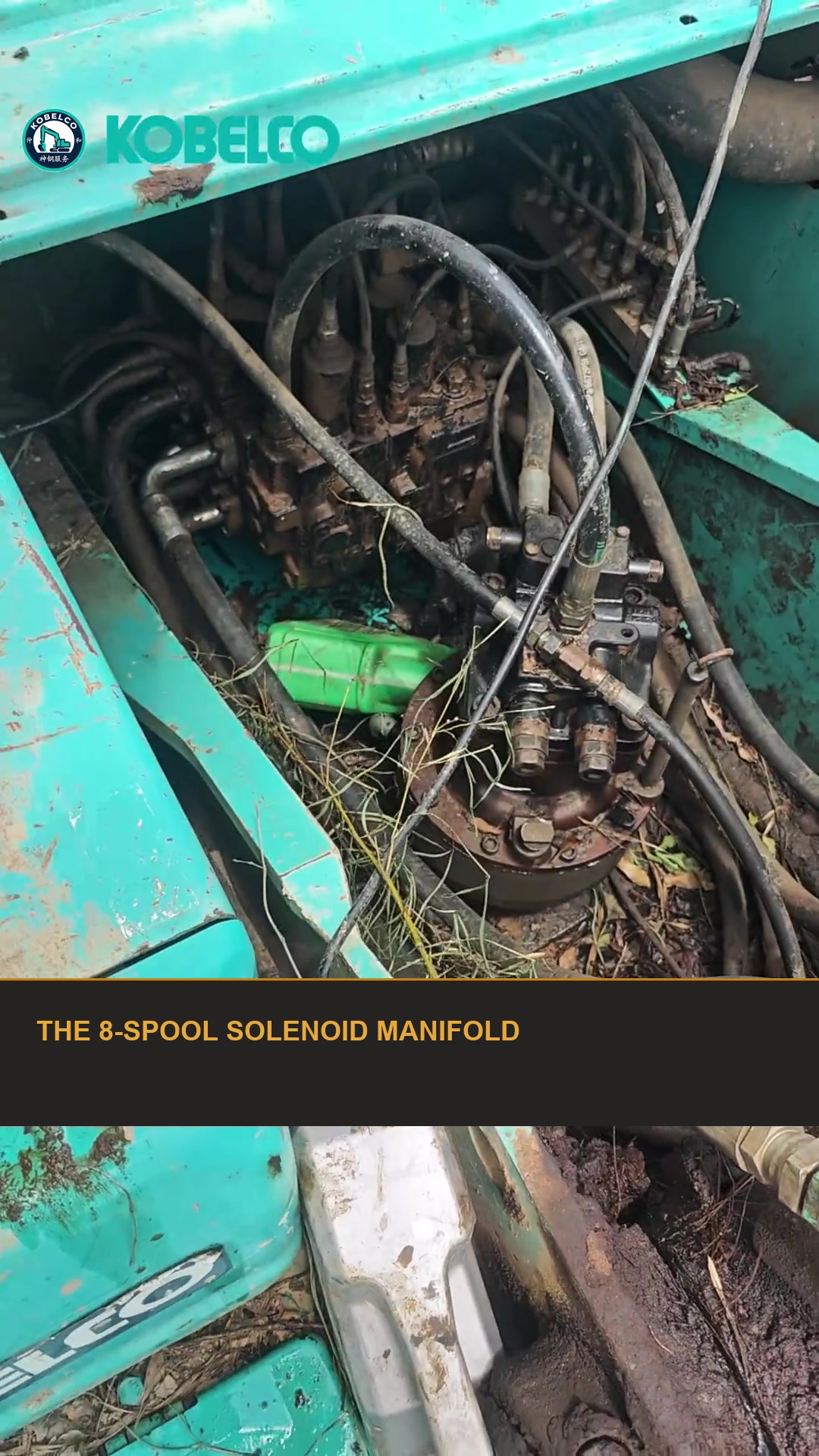
Inspection found several valves on the bank sticking rather than one failed coil. Each valve was pulled, its spool and bore cleaned, and the bank reassembled.
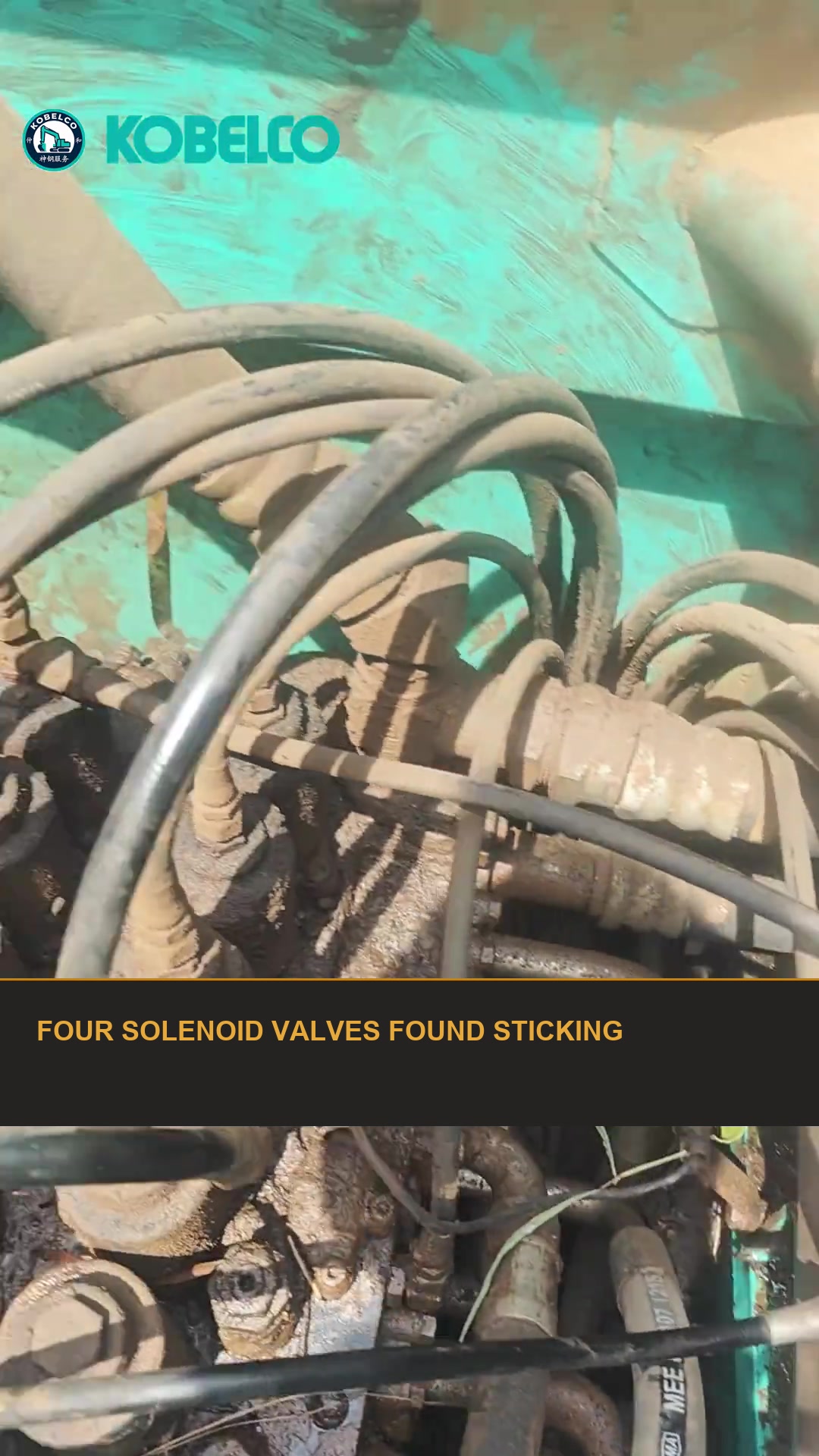
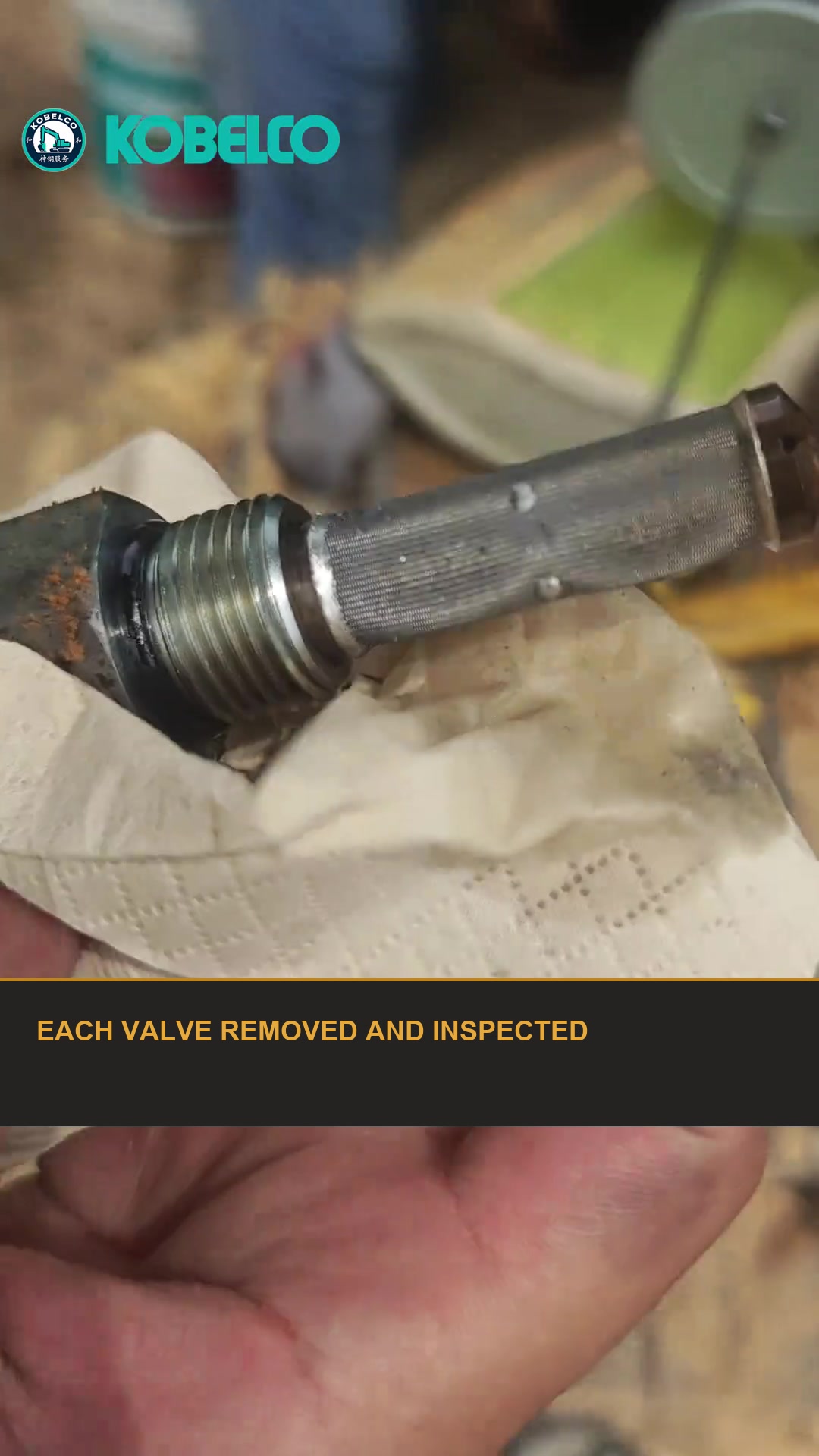
Machine speed returned immediately after the cleaned valves were refitted. At this point the job looks finished, and this is exactly where it usually goes wrong. The valves were the symptom. The hydraulic tank was opened next, and the oil was found dark and degraded. That finding turns a valve-cleaning job into an oil-and-filtration job.
Why several valves stick together, not just one
An on/off solenoid and a proportional valve both work with very small clearances between a spool and its bore. Those clearances are measured in microns. Oil that has oxidised, overheated or picked up fine particles deposits varnish and debris in exactly that gap. The spool still moves, but it moves late, with drag, and with a delayed pressure build-up. Multiply that by several valves fed from the same supply and you get the classic whole-machine symptom: every function responds, but every function is slow.
Three details make this mechanism recognisable:
One shared supply. The SK200-8 parts catalogue shows an eight-position solenoid bank labelled A1–A8. All eight are fed from the same hydraulic system. There is no reason for degraded oil to pick just one position.
Mechanical drag, not an electrical fault. A coil or harness fault tends to affect one channel and is often visible to the controller's self-diagnostic function. Mechanical sticking from varnish leaves the electrical side looking normal — command current present, valve response late.
Slow rather than dead. A valve that still shifts but shifts late produces slow movement, not zero movement. This is the distinction between case (1) as "slow" and a machine that will not respond at all.
So start with the physical checks. Pull the pilot line filter and look for blockage. With the valves open, inspect the orifices and sliding surfaces for debris and feel whether each spool drags instead of moving freely; clean anything you find. Then confirm with the pressure readings in the next section before ordering parts.
What the factory manual says to measure
Chapter 47 case (1) is a 17-step table that runs from the electrical unlock chain through the pilot circuit, the proportional valves, the main relief setting, the pump regulator and finally the pump itself. Two of its ideas are worth keeping in mind:
1. Command first, output second. Several steps ask you to compare the command current shown on the service diagnostic screen with the measured value. If the controller is commanding correctly and the measured secondary pressure is wrong, the fault is downstream in the valve or the oil. If the command itself is wrong, look at the controller, sensors and harness. 2. A port pressure is the proof. The manual measures secondary pressure at named ports on the eight-position valve body: A7 and A5 for the P1/P2 unload proportional valves, a3 and a4 for the P1/P2 pump proportional valves, and A1 for the lock solenoid. Those labels correspond to the A1–A8 position family shown in the parts catalogue.
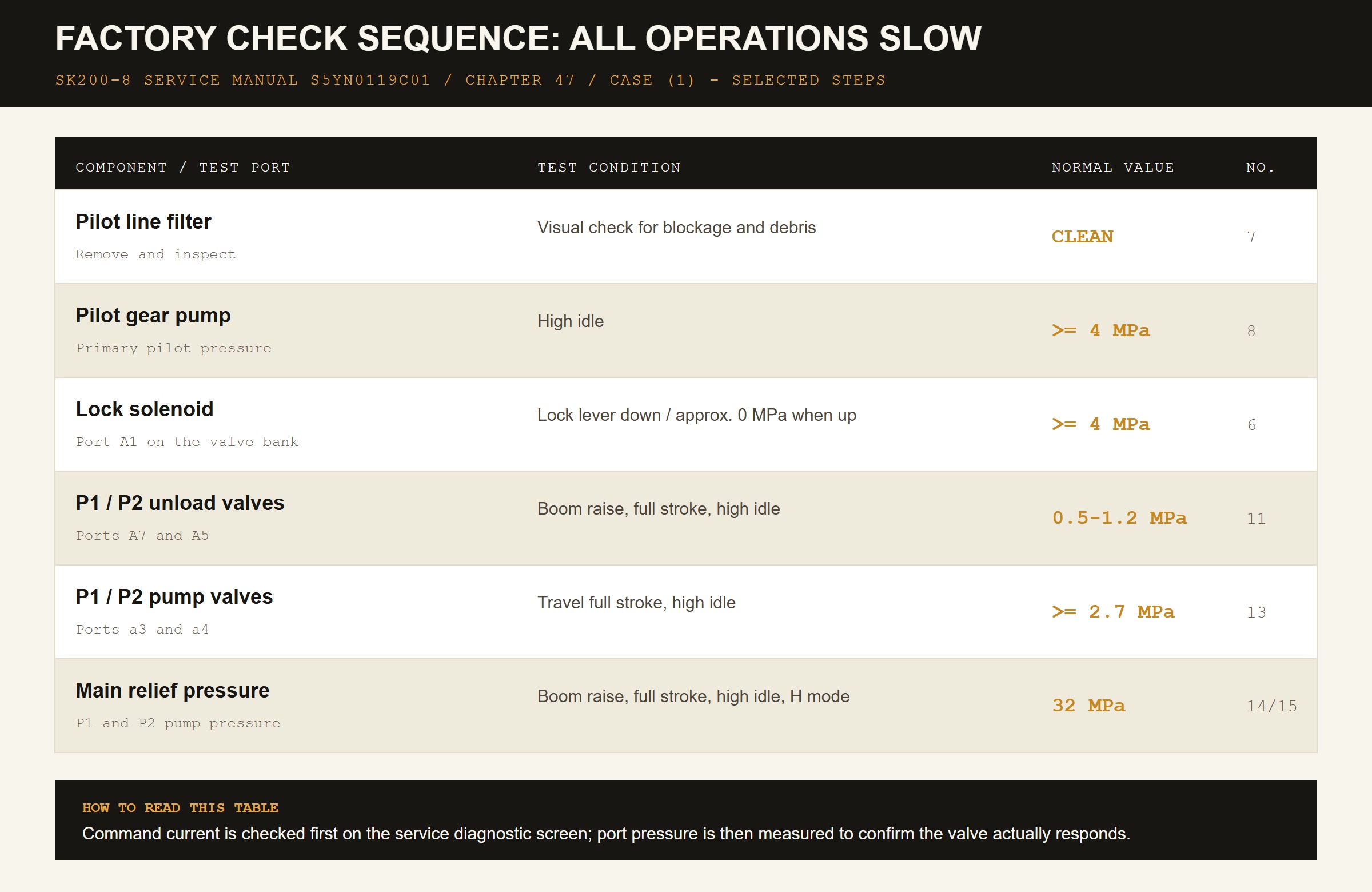
| Component / port | Test condition | Normal value | Case (1) step |
|---|---|---|---|
| Pilot line filter | Remove and inspect for blockage | Clean | No. 7 |
| Pilot gear pump, primary pilot pressure | High idle | ≥ 4 MPa | No. 8 |
| Lock solenoid, port A1 | Lock lever down (approx. 0 MPa with lever up) | ≥ 4 MPa | No. 6 |
| P1 / P2 unload proportional valves, ports A7 and A5 | Boom raise, full stroke, high idle | 0.5–1.2 MPa | No. 11 |
| P1 / P2 pump proportional valves, ports a3 and a4 | Travel full stroke, high idle | ≥ 2.7 MPa | No. 13 |
| Main relief, P1 and P2 pump pressure | Boom raise, full stroke, high idle, H mode | 32 MPa | No. 14 / 15 |
Source: Kobelco SK200-8 / SK210LC-8 service manual S5YN0119C01, chapter 47, case (1). Values apply to the stated test conditions on this model only.
Three cautions on those numbers:
Conditions are part of the value. "High idle", "full stroke" and "H mode" are not optional detail. Measuring at low idle or with a partial lever stroke gives a different number and will send you after a healthy valve.
Do not mix adjustment values with fault values. The normal unload-valve adjustment current on the A/B/C adjustment screen is 520–635 mA. That is a calibration reading during an adjustment routine, not a diagnostic pressure value, and not a coil resistance. Our A/B/C adjustment guide covers that routine separately.
Port labels are model-specific. A7, A5, a3, a4 and A1 belong to this SK200-8 documentation. Later generations use different valve families and port naming — see our SK-8 solenoid valve locations and interchangeability guide before carrying a number across models.
The practical workflow is: read the command current and the pressure sensor values on the service diagnostic display, then confirm with a gauge at the named port. When the controller commands correctly but the port pressure sits outside the range, the valve or the oil feeding it is the suspect. That is the moment to clean and inspect — and to look at the oil.
Cleaning the valves: what it proves and what it does not
Cleaning a sticking valve is a useful binary test, not a complete repair. If removing varnish and debris restores valve response and machine speed, you have proved that the pump, the regulator and the main control valve were not the failed parts. That is worth a great deal: it rules out the most expensive component on the machine.
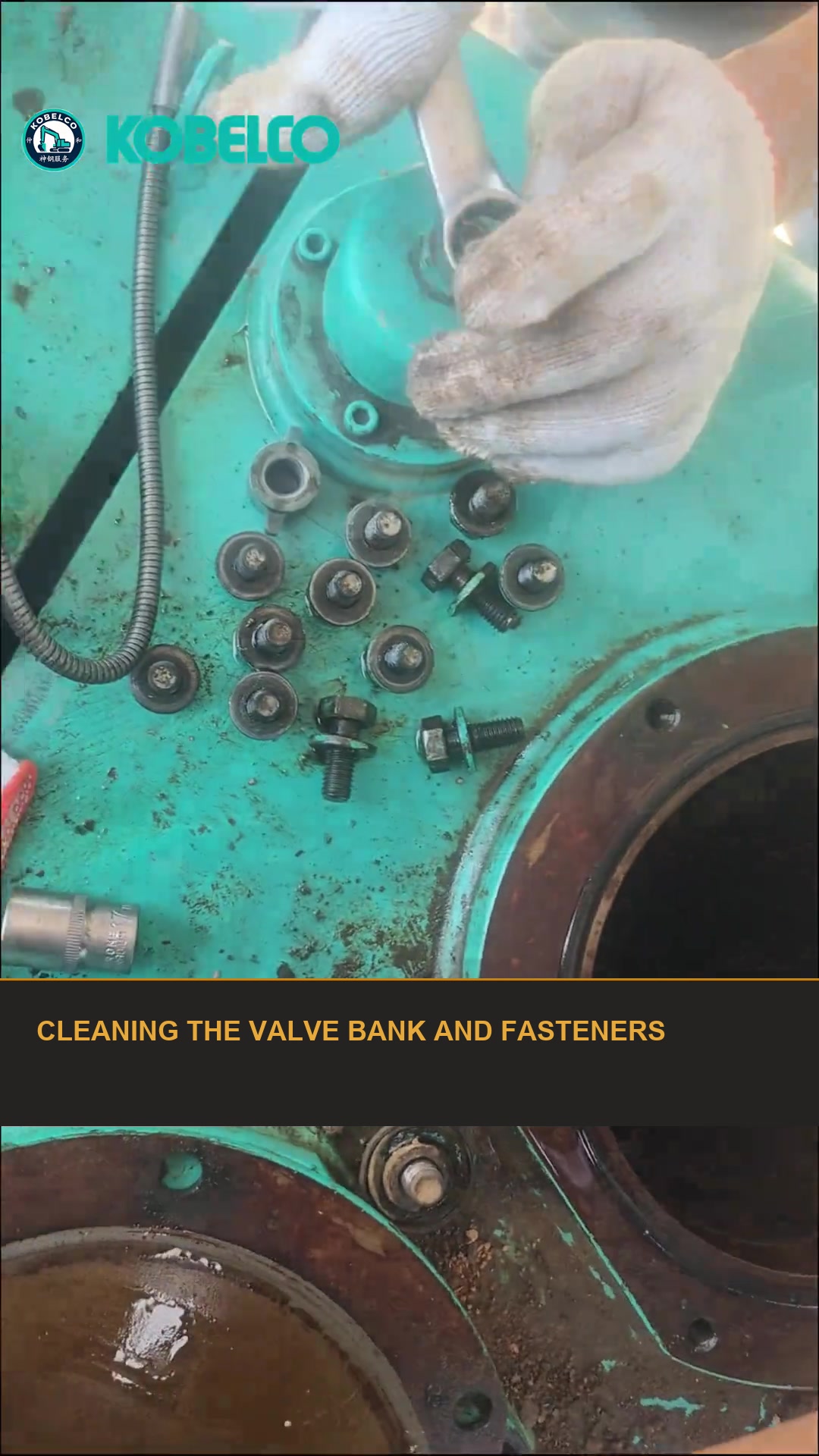
For the detailed disassembly and cleaning procedure, use our SK-8 solenoid valve cleaning guide. In brief:
Keep each valve with its own position. The eight positions are not automatically interchangeable; mixing them creates a new fault that looks like the old one.
Clean the bore and the orifices as well as the spool. A polished spool in a varnished bore will stick again immediately.
Do not use hard tools or abrasives on the spool lands. Scoring the clearance turns a cleaning job into a replacement job.
Replace damaged seals, refit to the specified torque, and re-measure the port pressures rather than trusting a short test drive.
What cleaning does not prove: that the oil is still serviceable, that the filters are doing their job, or that the valves will stay free. Those are separate questions, and on this fault they are the ones that decide whether the machine is still slow next month.
Do not stop there: the oil is the root cause
On this machine the tank was opened after the valves were cleaned. The oil was dark, degraded and far from the condition it should be in.
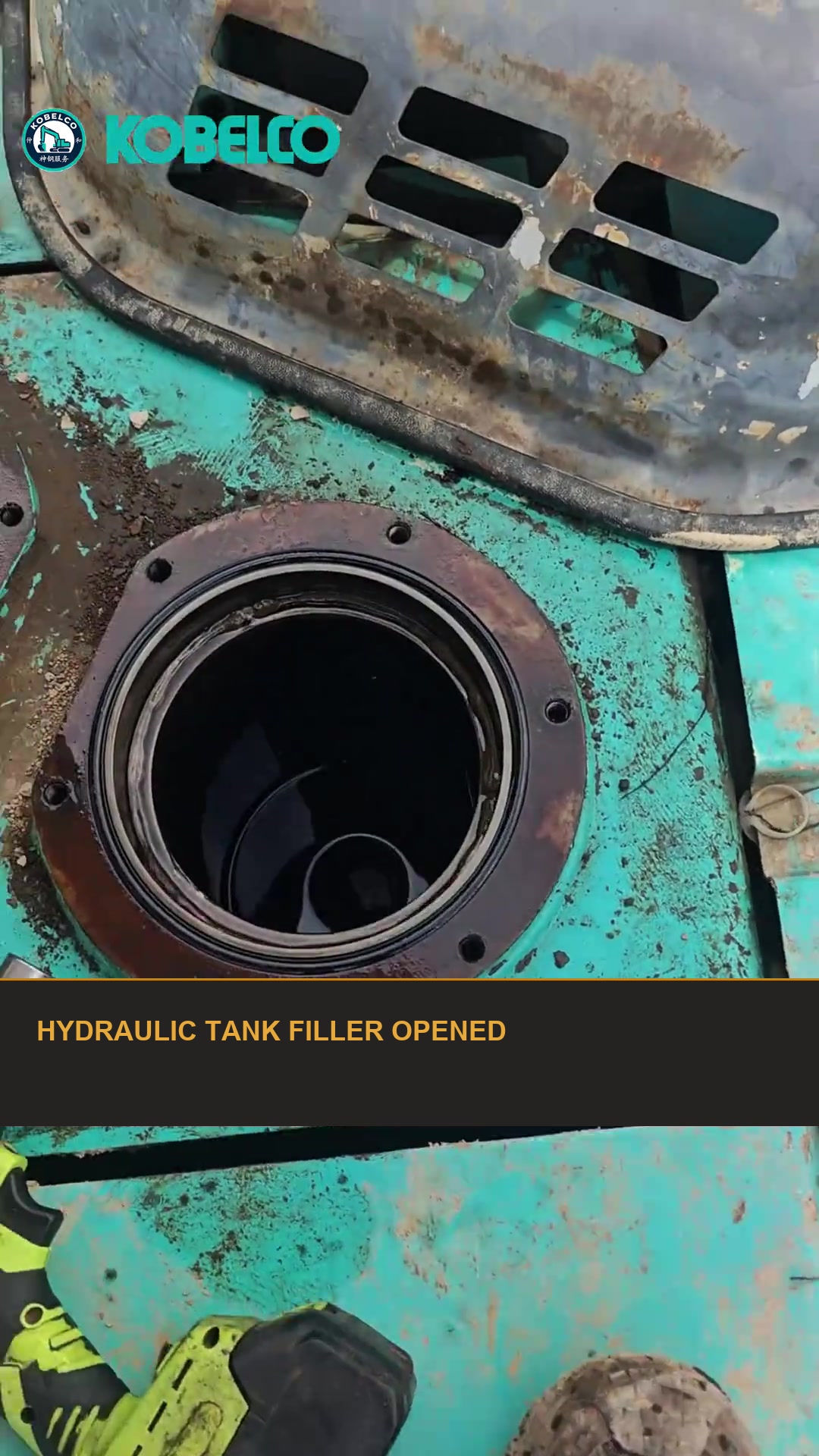
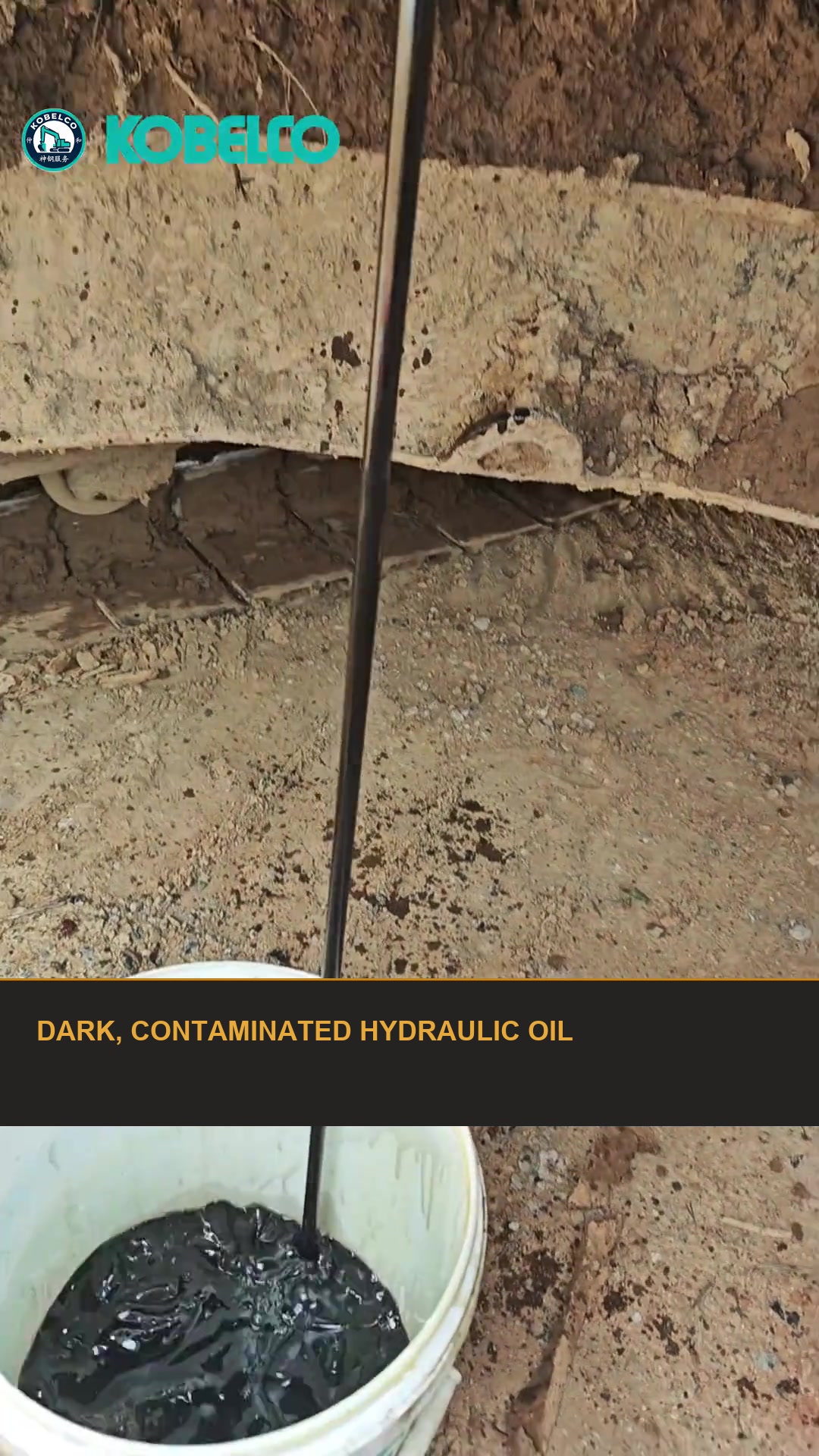
Dark oil is why the job is not finished when the valves are cleaned. The oil, the tank and the loaded filters are still in the circuit, so the same valves can stick again. Change the oil and filters as part of this repair, in the same visit: drain the old oil, clean the tank and suction strainer, fit new return and breather filters, refill with the correct grade to the specified level, bleed the system, then re-measure the port pressures from the table above. The full order is in A repair order that actually holds.
Do not wait for the next scheduled service. The SK-8 maintenance counter defaults are 5,000 hours for hydraulic oil and 1,000 hours for the hydraulic oil filter (engine oil and fuel filter 500 hours each), but those are starting values, not a fixed interval — oil in the condition shown above is reason enough to change it now.
Our Kobelco filter kits page lists the filters that belong in an SK200-8 service in one order, so the oil change and the filtration change happen together.
The recurrence loop
This is the part most often skipped, and the reason the same machine comes back.
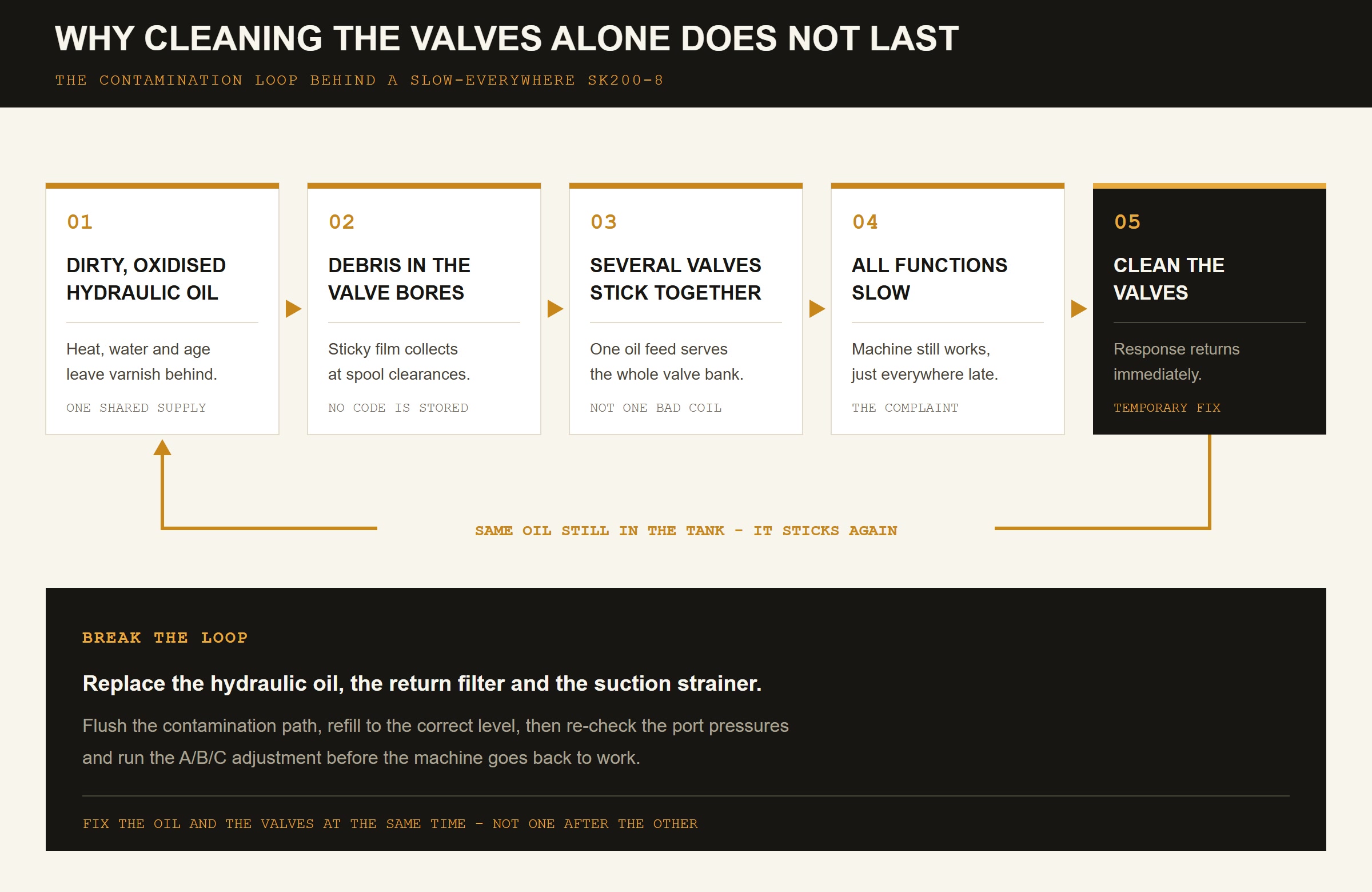
The sequence is simple and self-reinforcing:
Degraded oil deposits varnish and carries fine particles.
Deposits collect at the spool clearances across the whole valve bank.
Several valves become sluggish together, so every function slows down.
Cleaning the valves restores response immediately — a convincing but short-lived result.
The same oil, the same reservoir and the same loaded filters are still in the circuit.
The valves stick again, commonly sooner the second time because the bores already carry residue and light scoring.
Field experience with this fault is that the complaint returns within weeks when only the valves are cleaned. How soon depends on oil condition, operating temperature, hours and how thoroughly the system was flushed.
| Approach | Immediate result | What happens next |
|---|---|---|
| Clean the valves only | Machine speed returns the same day | Contaminated oil re-deposits in the bores; symptom returns |
| Clean the valves, change oil and filters, re-measure, re-adjust | Machine speed returns and stays | Root cause removed; pressure values remain in range |
A repair order that actually holds
Work in this order. Skipping the measurements is what turns an oil-and-filtration job into a parts-ordering exercise.
Record the starting condition. Model, serial number, hour meter reading, oil appearance, and which functions are slow. Photograph the nameplate before anything is removed.
Read the service diagnostic display first. Capture command currents and pressure sensor readings for the P1/P2 unload and pump proportional valves. Write them down; you will compare after the repair.
Measure the port pressures in the factory table above under the stated conditions. This is your baseline and your acceptance test.
Clean the valve bank and the pilot line filter, keeping each valve in its original position. Follow the valve cleaning procedure.
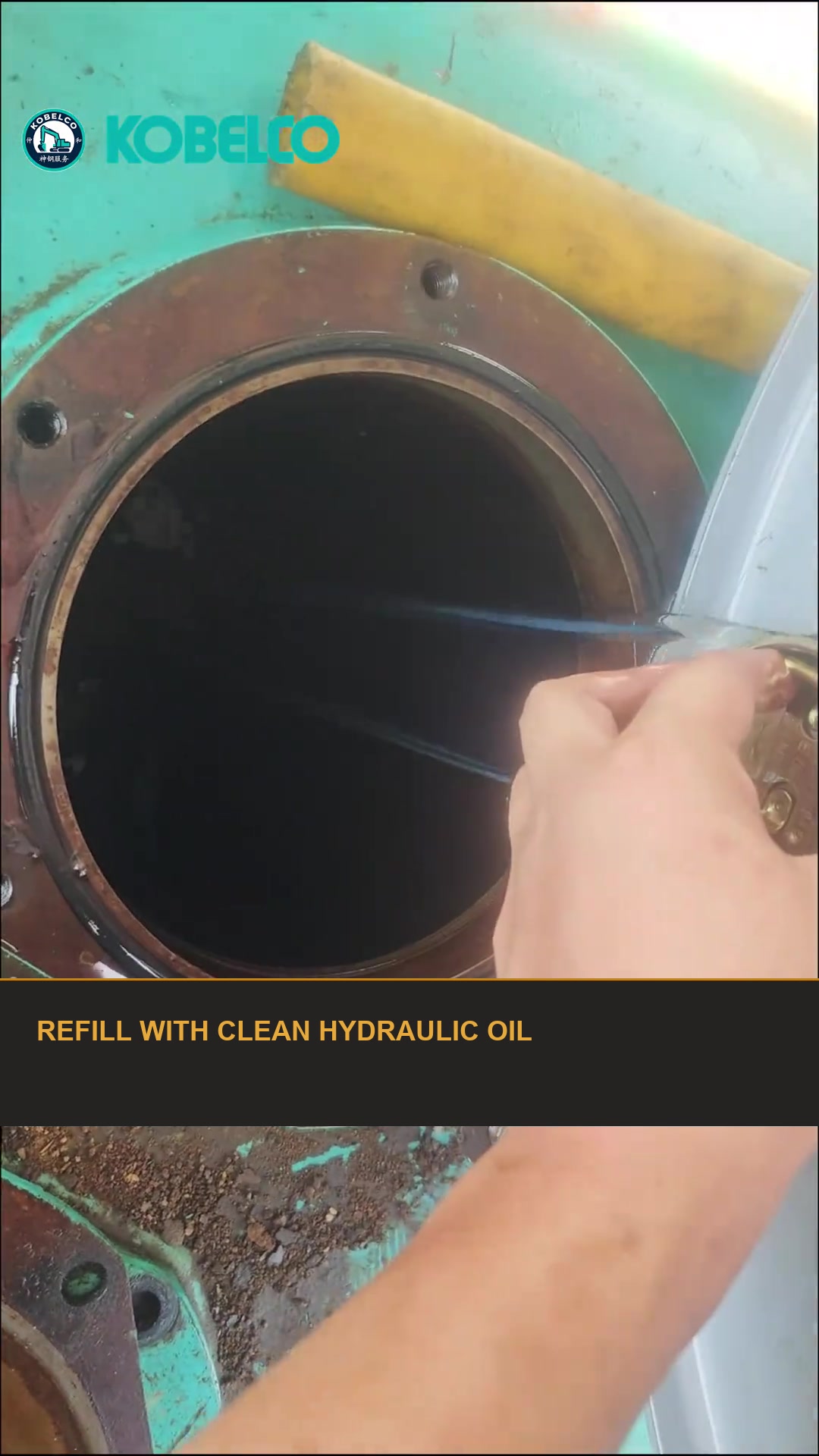
Drain and refill the hydraulic system. Drain while the oil is warm but safe to handle, clean the tank interior and suction strainer, and replace the return filter and the tank breather element. Relevant SK200-8 items: hydraulic filter, second hydraulic filter and breather filter.
Refill with clean oil of the correct specification and grade to the specified level, then bleed air from the circuit following your machine's procedure.
Re-measure the same port pressures. They are the proof that the valves and the pump control are now behaving as the manual expects.
Run the A/B/C adjustment if valves or pump control components were disturbed, and confirm the unload valve adjustment current is in the normal window. See the A/B/C adjustment guide.
Re-test under the same conditions that produced the complaint — warm oil, high idle, full lever stroke, all functions cycled. Confirm that the slowness is gone and that no function lags behind the others.
One more discipline point: do not replace the main pump, the regulator or the whole solenoid bank "while we are in there". Measure, clean, change the oil and filters, then measure again. Replace only the parts that still fail a documented test.
Parts and consumables commonly involved
The table below deliberately names categories, not sales part numbers. Service manuals identify components by function, figure number and port label; they do not list retail part numbers. The parts catalogue for this solenoid bank shows an assembly number for the complete bank and separate numbers for the individual valves — those are different levels of the same assembly and must not be substituted for one another. Which valve number belongs to which function has to be confirmed against your serial number and the catalogue sub-illustrations.
| Category | Role in this repair | Where to look |
|---|---|---|
| Hydraulic oil, correct grade | Removes the contamination that caused the sticking | Filter service kits |
| Return / hydraulic oil filter | Stops recirculating particles | SK200-8 hydraulic filter |
| Suction strainer and tank breather | Keeps the reservoir and incoming air clean | Second hydraulic filter · Breather filter |
| Pilot line filter | Case (1) step 7 — inspect and clean | SK-8 solenoid valve guide |
| Solenoid / proportional valves | Replace only if a valve still fails after cleaning and pressure re-test | Electrical parts category |
| Seals and fasteners | Renew during reassembly | Electrical parts category above |
Send the model, serial number, hour meter reading, a photo of the nameplate and a photo of the old part's connector. Our engineers confirm the replacement list before quoting — that is the only reliable way to map a function to a part number on this machine.
What each check proves — and what it does not
| Check | What it proves | What it does not prove |
|---|---|---|
| Counting how many functions are slow | Whether the cause is shared or circuit-specific | Which component is at fault |
| Command current on the service diagnostic display | The controller is asking for the right output | That the valve actually responded |
| Port pressure at A7 / A5 / a3 / a4 / A1 | The hydraulic output of that valve under load | Coil condition, or oil quality |
| Pilot line filter inspection | Whether debris is reaching the pilot circuit | The condition of the oil in the tank |
| Valve cleaning restores speed | The pump and regulator were not the failed parts | That the repair will last |
| Oil colour and smell | A strong reason to sample and change the oil | A laboratory-grade oil analysis |
| Re-measuring after the repair | The machine now meets the factory values | That a new contamination source is absent |
Binary tests localise a fault; measurements size it. Close every diagnosis with a recorded pressure value and a re-test under the conditions that produced the complaint.
Frequently asked questions
Why are all my functions slow at the same time?
Because the fault is in something every circuit shares. On an SK200-8 the usual candidates are pilot oil supply, the P1/P2 unload and pump proportional valves, the eight-position solenoid bank, the main relief setting, and the condition of the hydraulic oil. Several valves dragging at once from varnish or fine debris is a typical shared-cause failure, and it produces exactly this symptom: everything works, everything is late.
Is a worn main pump the likely cause?
Usually not. A main pump in poor condition normally leaves some circuits weaker than others, or announces itself with noise and heat. When five functions are equally slow and the engine sounds normal, work through the chapter 47 case (1) checks before condemning the pump. That table reaches the pump only at steps 16 and 17, after the electrical unlock chain, pilot supply, solenoid valves, proportional valves and main relief have all been cleared.
Can dirty hydraulic oil really slow down an excavator?
Yes, through the control valves rather than through the pump. Oxidised oil deposits varnish at spool clearances measured in microns. The spool still shifts, but it shifts late and with drag, so secondary pressure builds slowly and every movement lags. The factory manual reflects this: case (1) includes a pilot filter blockage check, and other chapter 47 tables repeatedly call for checking orifices and sliding parts for foreign matter and abnormal sliding resistance, with cleaning as the corrective action.
What pressure values should I see on an SK200-8?
For chapter 47 case (1): pilot gear pump primary pressure ≥ 4 MPa at high idle; lock solenoid port A1 ≥ 4 MPa with the lever down; P1/P2 unload proportional valve secondary pressure at ports A7 and A5 between 0.5 and 1.2 MPa during boom raise at full stroke and high idle; P1/P2 pump proportional valve secondary pressure at ports a3 and a4 ≥ 2.7 MPa during travel at full stroke and high idle; main relief 32 MPa in H mode. These values belong to this model and these test conditions.
Is cleaning the solenoid valves enough?
No. Cleaning restores speed and confirms the diagnosis, but the oil that caused the sticking is still in the tank, and the loaded filters are still in the circuit. Field experience with this fault is that the symptom returns when only the valves are cleaned. Change the oil and filters, clean the tank and suction strainer, then re-measure the port pressures and re-run the A/B/C adjustment.
How often should the hydraulic oil and filters be changed?
Maintenance counter defaults are 5,000 hours for hydraulic oil and 1,000 hours for the hydraulic oil filter; engine oil and fuel filter are both 500 hours. These are initial counter values, not a guarantee for every job. High temperature, heavy duty cycles, water ingress or visible degradation are all reasons to sample the oil and change it earlier. Confirm the interval against your own machine's manual and oil analysis.
Do I need to replace all eight solenoid valves?
Almost never. Ordering a full bank because several functions are slow treats a system condition as eight separate component failures. Clean and inspect the valves and bores, change the oil and filters, then re-measure. Replace only a valve that still fails a documented pressure test, and confirm its number by serial number, position and connector — an assembly number for the whole bank is not an individual valve number.
Not sure which filter kit or valve fits your machine?
Send the model, serial number, hour meter reading and a photo of the nameplate and the old connector. Our engineers confirm the replacement list before quoting.
Request a part number check