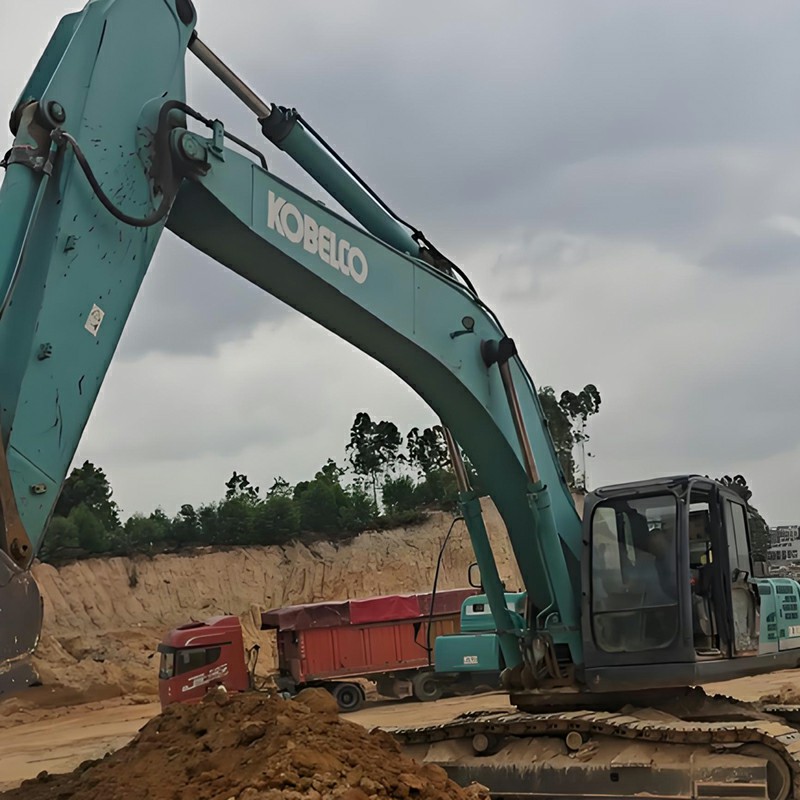
FIELD NOTES / SK200-8 & J05E-TA / SAFETY LOCK & PILOT CIRCUIT
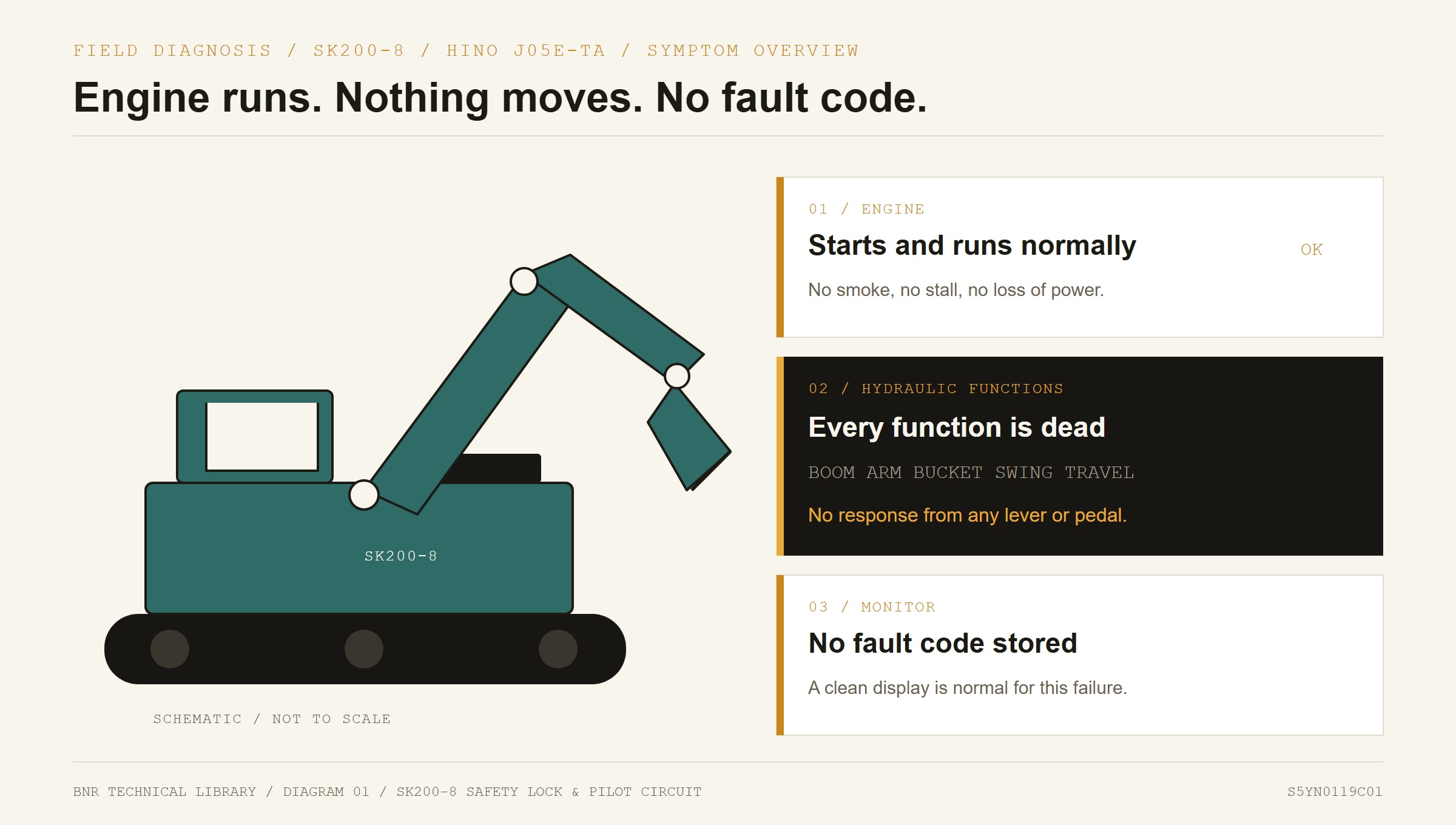
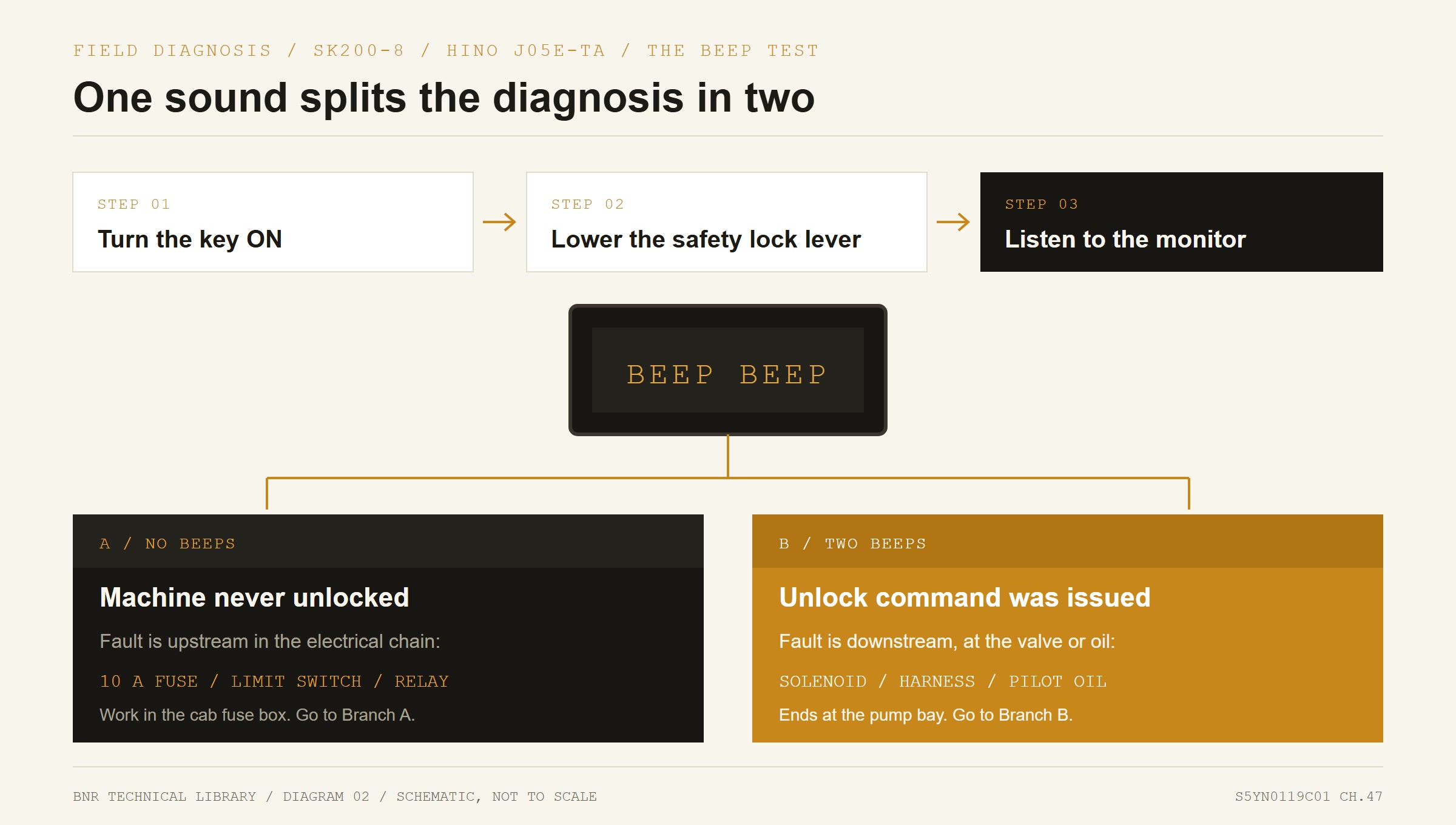
Your Kobelco starts, the engine sounds normal, and nothing moves. No boom, no arm, no bucket, no swing, no travel — and the monitor shows no fault code at all. Before you reach for a pressure gauge or order a hydraulic pump, do one thing: turn the key on, lower the safety lock lever, and listen for two short confirmation beeps from the monitor.
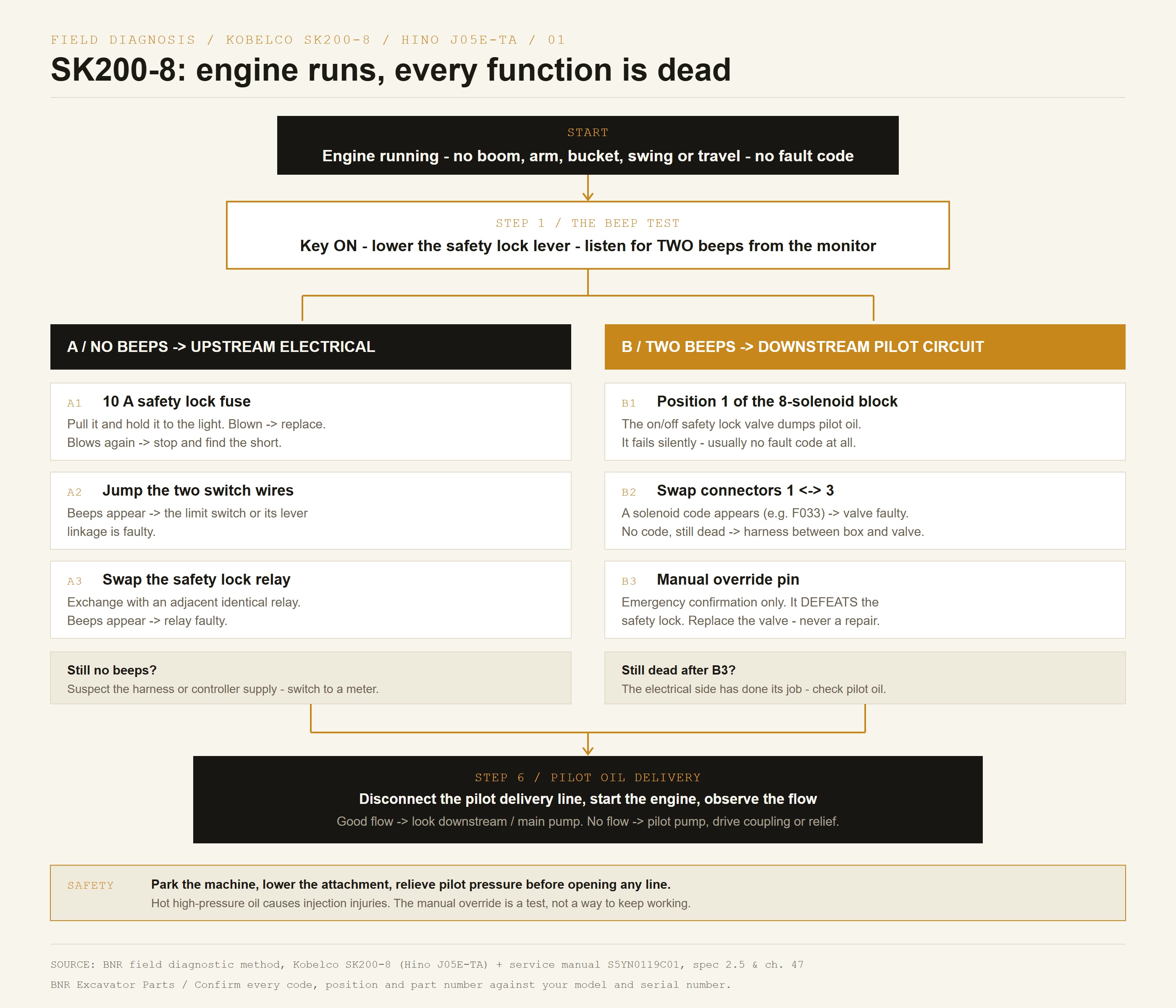
That sound splits the diagnosis in two. No beeps means the machine never unlocked, so the fault sits upstream in the safety lock electrical circuit — fuse, switch or relay. Two beeps means the controller did unlock the system, so the fault sits downstream at the position-1 safety lock solenoid, its harness, or the pilot oil that physically shifts the main control valve spools.
This guide documents the no-instrument field sequence used by working Kobelco technicians on site: bypass tests and swap tests instead of multimeters and gauges. It is a triage method, not a substitute for measurement — at the end of every branch we tell you which reading to take to confirm the call. If you already have a meter and a pressure gauge, our 4-check diagnostic guide is the faster route. This guide is written for a Kobelco SK200-8 with the Hino J05E-TA engine — see which machines this covers before you apply the sequence to yours.
On this page
Machine covered: SK200-8 with the Hino J05E-TA
This guide is written for a Kobelco SK200-8 — the 20-tonne SK-8 series excavator powered by the Hino J05E-TA engine. We state that up front because fuse positions, solenoid numbering, code assignments and part numbers are model-specific. A sequence confirmed on an SK200-8 should not be copied onto an SK-10 or another brand without checking that machine's own manual.
| Specification | SK200-8 as covered here |
|---|---|
| Model family | Kobelco SK-8 series; the same service manual also covers SK210LC-8 |
| Engine | Hino J05E-TA — 4-cylinder, water-cooled, direct injection, turbocharged with intercooler |
| Displacement | 5.123 L (112 mm bore × 130 mm stroke) |
| Rated output | 114 kW / 2,000 min⁻¹; maximum torque 572 N·m / 1,600 min⁻¹ |
| Hydraulic pumps | 2 variable-displacement axial-piston pumps + 1 gear pump (the pilot pump) |
| Control valve | Spool type, 8 sections |
| Operating weight | 20,600 kg |
Source: Kobelco SK200-8 / SK210LC-8 service manual S5YN0119C01, specification section 2.5.
The SK200-8 manual is issued in separate versions split by serial number (China-spec YN11-45001~ and China-produced YN11-C5001~); machines built for other markets use different prefixes. Position numbering, fault-code assignments and part numbers can change between production runs, so read the nameplate and confirm against your own manual before ordering anything.
Why "no fault code" is the normal result here
A dead machine with a clean monitor is not a mystery — it is a consequence of where the sensors are.
On Kobelco 8-series machines, the controller watches the switch input from the safety lock lever. It does not monitor the hydraulic output of the solenoid valve downstream. When the safety lock solenoid fails, the controller still sees a perfectly valid "lever down" signal, so there is nothing to log. The valve is a simple on/off cartridge: energised, it opens pilot oil to the joysticks; de-energised, it dumps that pilot circuit and the whole machine goes inert. One failure mode, one symptom, no code.
The Kobelco service manual reflects this split. Chapter 47 of the SK200-8 manual organises faults by symptom, alongside a separate branch for diagnostic codes — mechanical, hydraulic and pilot-circuit failures live in the symptom branch. The Hino J05E engine manual makes the same distinction explicit in its four-step method: interview the operator, reproduce the symptom, then follow either the code-based or the symptom-based analysis path, and finally re-test under the original conditions. In other words, "no fault code" is a reason to change method, not a reason to keep scanning for codes.
Before you start: safety
This is a safety-critical circuit. Read this once before touching anything.
Park on level ground, lower the attachment to the ground, stop the engine and keep everyone clear of the swing radius and the working area.
The pilot circuit can hold residual pressure after shutdown. Relieve it following the procedure in your machine's service manual before removing any connector or line.
Never loosen a hydraulic line on a running engine unless you are trained and equipped for it. Hot, high-pressure oil causes injection injuries that are not visible from the outside.
The manual override described in step B3 deliberately defeats the safety lock. It is a diagnostic confirmation and, at most, a way to move a stuck machine to a safe position. It is not a repair, and a machine must not be returned to work in that state.
The procedures below are documented on an SK200-8 (J05E-TA) and apply most directly to the SK-8 family. The diagnostic logic transfers to other Kobelco generations, but position numbers, code assignments and part numbers do not — confirm them for your machine before ordering parts.
The decision tree at a glance
| Listen after lowering the lever | What it means | Go to |
|---|---|---|
| No beeps | The controller never received a valid unlock signal — fuse, lever switch, relay or their wiring | Branch A |
| Two beeps | Unlock command issued; the break is at the solenoid, its harness or the pilot oil supply | Branch B |
| Beeps, then a fault code | The controller has detected a specific circuit — read the code before swapping anything | Your service manual / code table |
The reason this split saves so much time is that the two branches need completely different tools. Branch A is electrical and mostly happens in the cab fuse box. Branch B ends at the pump bay. Crossing between them without the beep test is how a ten-minute fuse check turns into an unnecessary pump order.
Branch A: no beeps from the monitor
If the monitor stays silent when the lock lever goes down, the controller has not unlocked the hydraulics. Work through the three components below in order — each one can be checked with a swap or a bypass, no meter required.
A1. The 10 A safety lock fuse
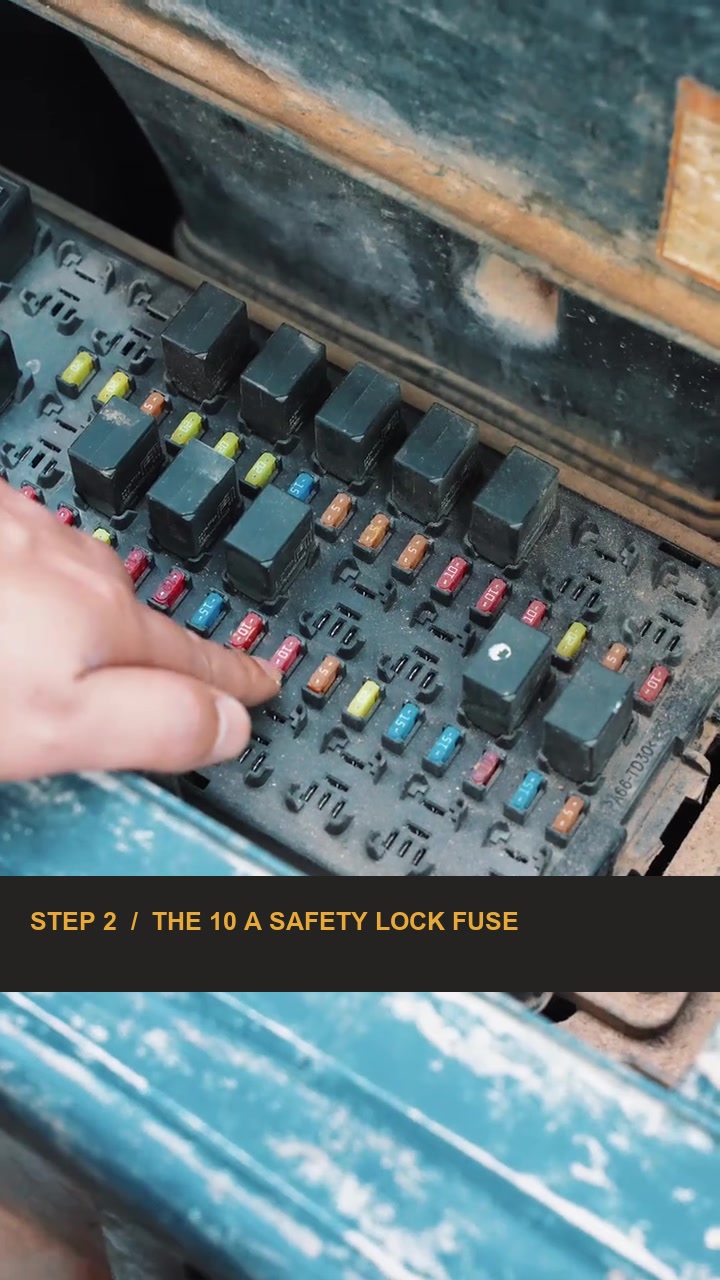
The safety lock circuit is fused separately from the main harness. If that fuse is open, the controller never unlocks and every lever stays dead while the engine runs perfectly. Pull the fuse and look at the element; do not judge it through the plastic. If a replacement blows immediately, stop — you have a short on that circuit and fitting more fuses will not fix it.
The catalogue number used for this fuse on SK200-8 is YN24E00016S006. See also our notes on what the 10 A fuse protects and the fuse box layout.
A2. Bypass the safety lock switch
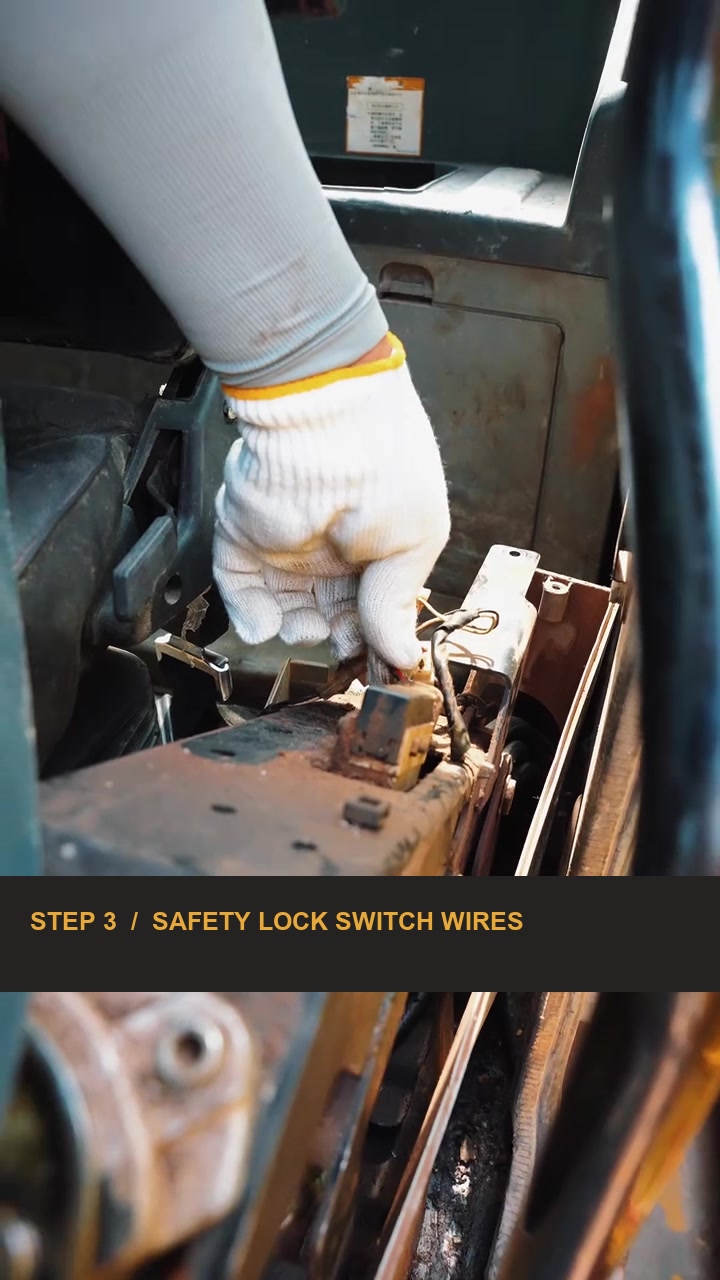
If the fuse is good, the next suspect is the limit switch that the lever operates. Disconnect it and momentarily join the two harness wires, then lower the lever again and listen. If the two beeps appear, the switch is faulty — or the lever linkage is worn enough that the lever moves but never actuates the switch. Watch the switch while a second person operates the lever before you condemn the electrical part.
A switch that stays open in both positions causes exactly the dead-machine symptom. A switch that stays closed in both positions is a different and more dangerous fault: the machine can move with the lever raised. Both are reasons to replace the switch, not to bypass it permanently.
Part number commonly listed: YN50S00041F1 — safety lock limit switch, SK200-8.
A3. Swap the safety lock relay
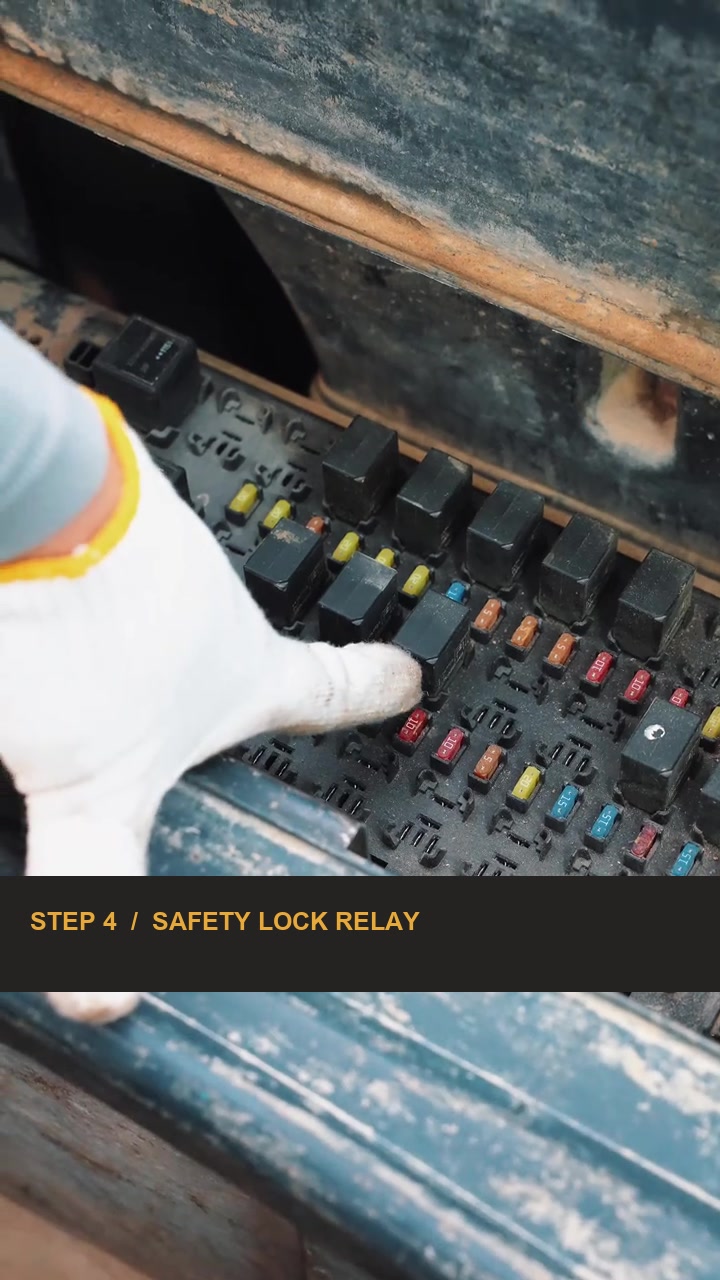
Still no beeps? Find the safety lock relay in the fuse/relay box and exchange it with an adjacent relay of the same type and rating. Lower the lever and listen again. Beeps return → the relay was the fault. No change → put both relays back and move to the harness and controller supply with a meter; at that point a swap test has told you everything it can.
This is the point where the no-tools method reaches its limit. A relay swap is a binary test: it proves which side of the circuit the fault is on, but it does not tell you a coil resistance, a supply voltage or a contact condition. Confirm with a continuity/voltage measurement before ordering a controller.
Branch B: two beeps, but nothing moves
The controller has unlocked. The break is now between the command and the pilot oil. On an SK200-8, the eight-solenoid valve block sits on the main valve body above the hydraulic pump, under the engine hood; the first position is the safety lock valve.
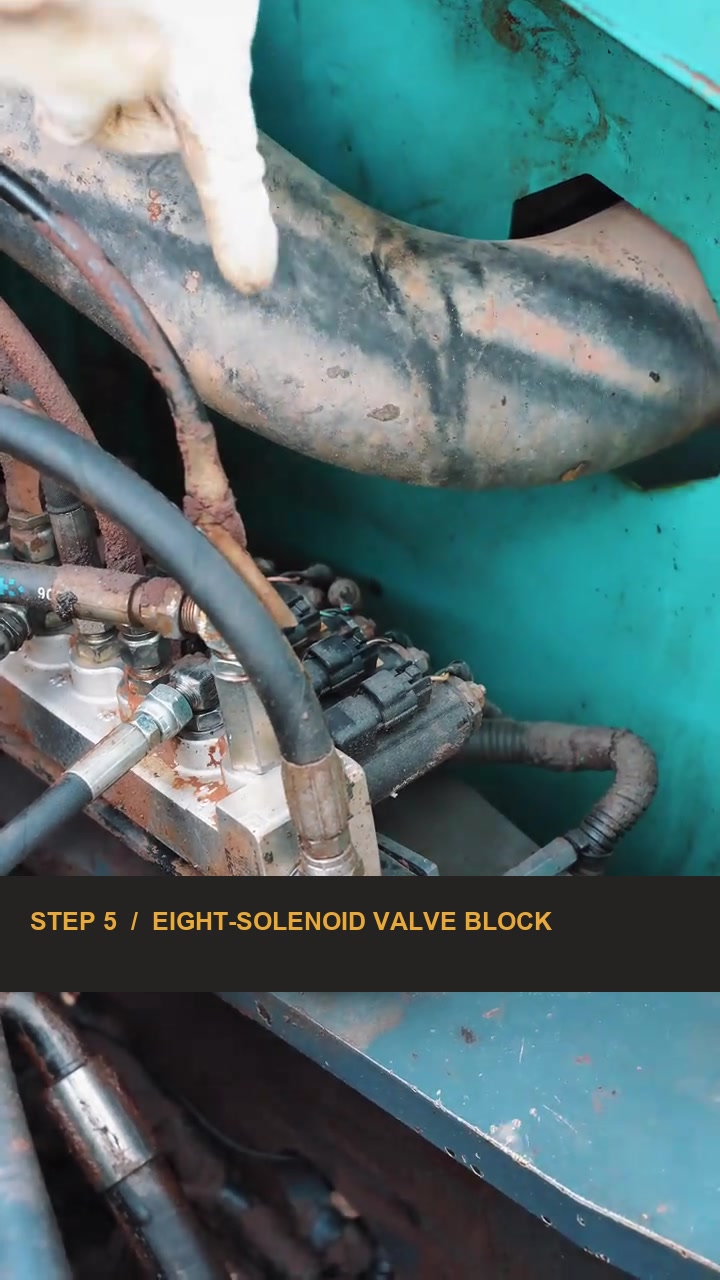
B1. Why position 1 fails silently
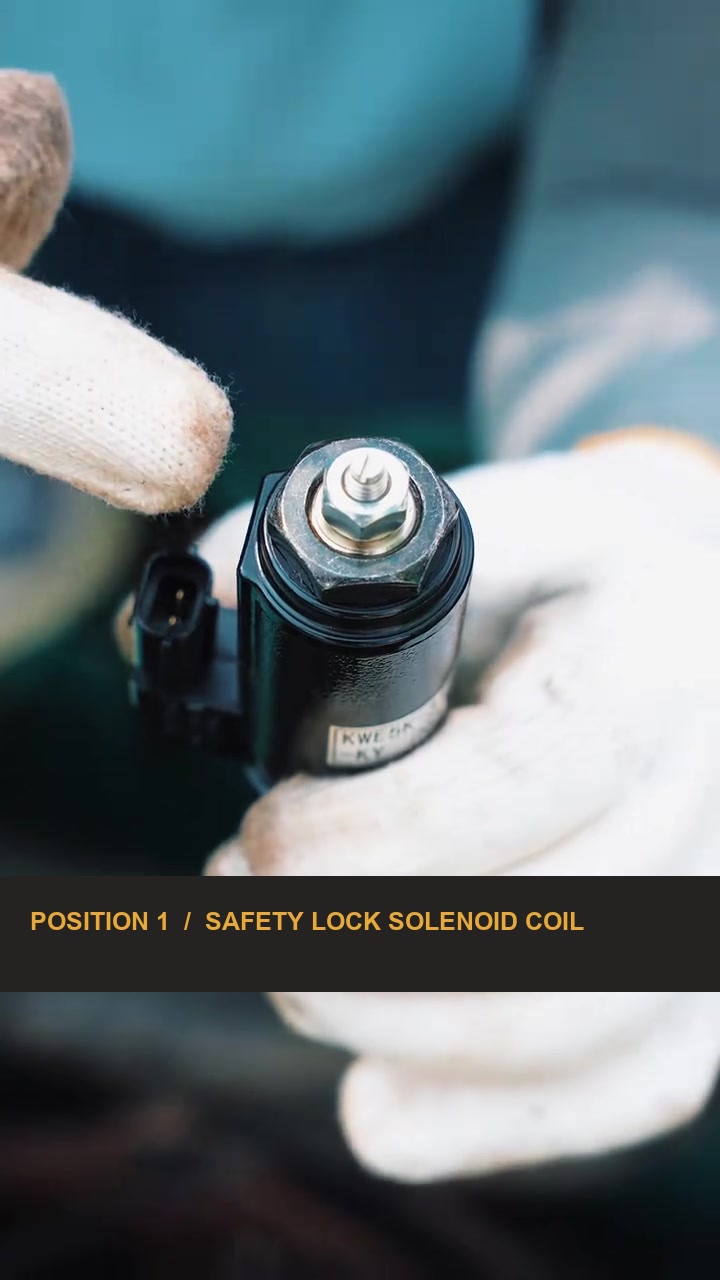
The safety lock solenoid is an on/off valve, not a proportional one. It carries a small hydraulic duty — open or block a pilot supply line — and its electrical duty is equally simple: energise to shift, spring back when de-energised. That simplicity is why the failure is so disorienting. Other valves on the block degrade into symptoms an operator can describe: slow, weak, hesitant. This one has a single symptom: nothing moves.
Because the controller treats the lever state as an input rather than monitoring the valve, a failed safety lock valve commonly stores no fault code at all. On SK-8 machines the valve at position 1 is commonly listed as YN35V00050F1 (KWE5K-31/G24DB50) — safety lock solenoid valve. A healthy 24 V coil in this family typically reads roughly 30–35 Ω; use the specification for your own part number rather than a generic figure.
Do not order "a solenoid valve for an SK200-8". Each of the eight positions has its own part number and its own behaviour, and an on/off valve will not substitute for a proportional one. Order by position, coil reference and a photo of the plug.
B2. The 1 ↔ 3 connector swap test
This is the cleverest step in the field method, and the one most often misunderstood. Swap the connectors, not the valves. Unplug the position-1 and position-3 coils and plug each harness connector into the other position, then turn the key on and lower the lever.
A solenoid-circuit code appears — commonly reported as
F033on this valve block — then the fault followed the valve, and the position-1 coil is the suspect. On SK200-8 blocks,F033is commonly assigned to the travel-speed position, which is why moving that channel's connector produces a code the controller recognises. Code allocation varies with model variant and serial number: read the code against your own manual rather than assuming a universal meaning.No code and still no movement means the electrical command is not reaching the valve at all. Look at the harness between the relay/fuse box and the solenoid block: chafed loom, corroded pins, a connector not fully seated, or a broken wire. A valve replacement will not fix a wiring fault — this is the most expensive misdiagnosis in the whole category.
Why the swap works: it gives you a known-good signal path and a known-good coil without owning a spare part. Whichever way the symptom moves tells you which half of the circuit is broken. It is the same logic as the relay swap in A3, applied one step further downstream.
B3. The manual override — emergency confirmation only
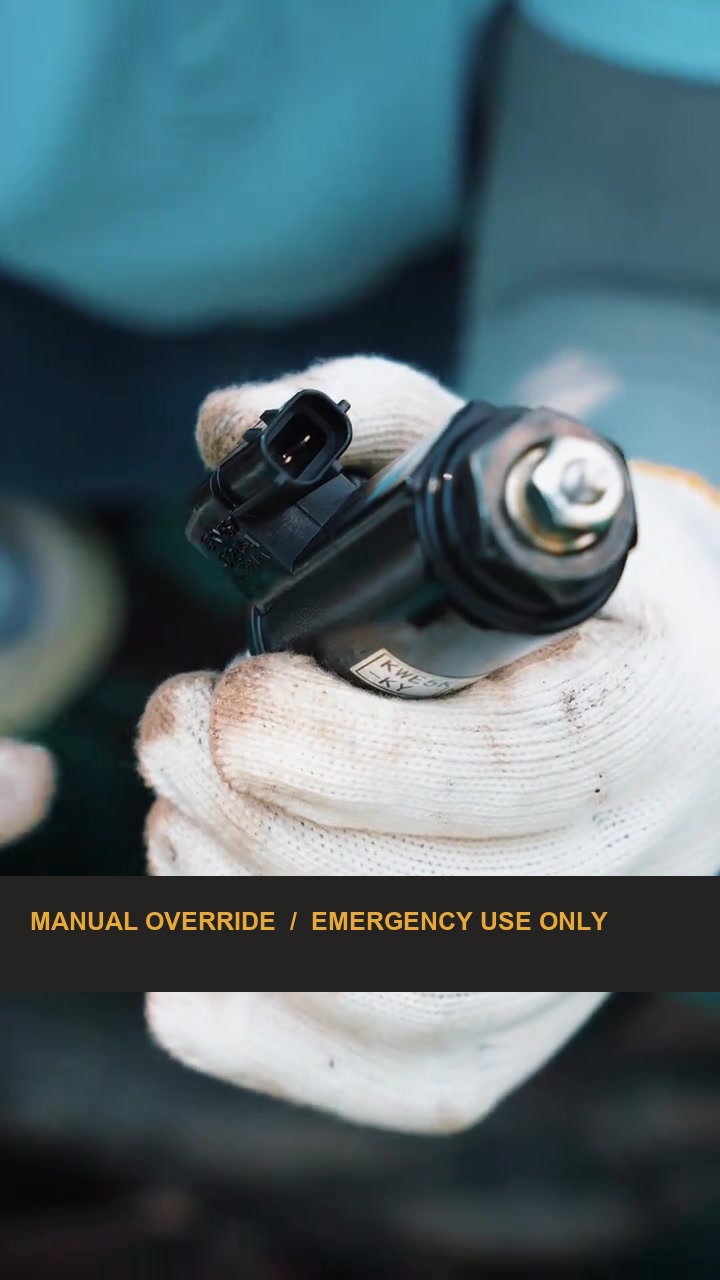
On most solenoid cartridges of this type, the end of the coil has a manual override pin under a lock nut. Loosen the nut, press the pin in until it sits flush with the nut, and retighten: the spool is now held in the open position and pilot oil passes continuously. If the machine's functions return at that moment, you have confirmed the fault is at the valve or its electrical supply, upstream of the hydraulic pump.
Read this before you try it. With the override engaged, the safety lock is defeated. The machine will still respond to the levers when the lock lever is raised, including while someone is entering or leaving the cab. We document it because technicians ask about it and because it is a legitimate last-step confirmation or a way to reposition a stranded machine — not because it is acceptable to keep working that way. Replace the valve, restore the override pin, and verify that raising the lock lever kills all functions before the machine goes back to service.
Still dead? Check pilot oil delivery
If the valve is confirmed open and the machine still will not move, the electrical side has done its job. The remaining common cause is that no pilot pressure exists to shift the main control valve spools.
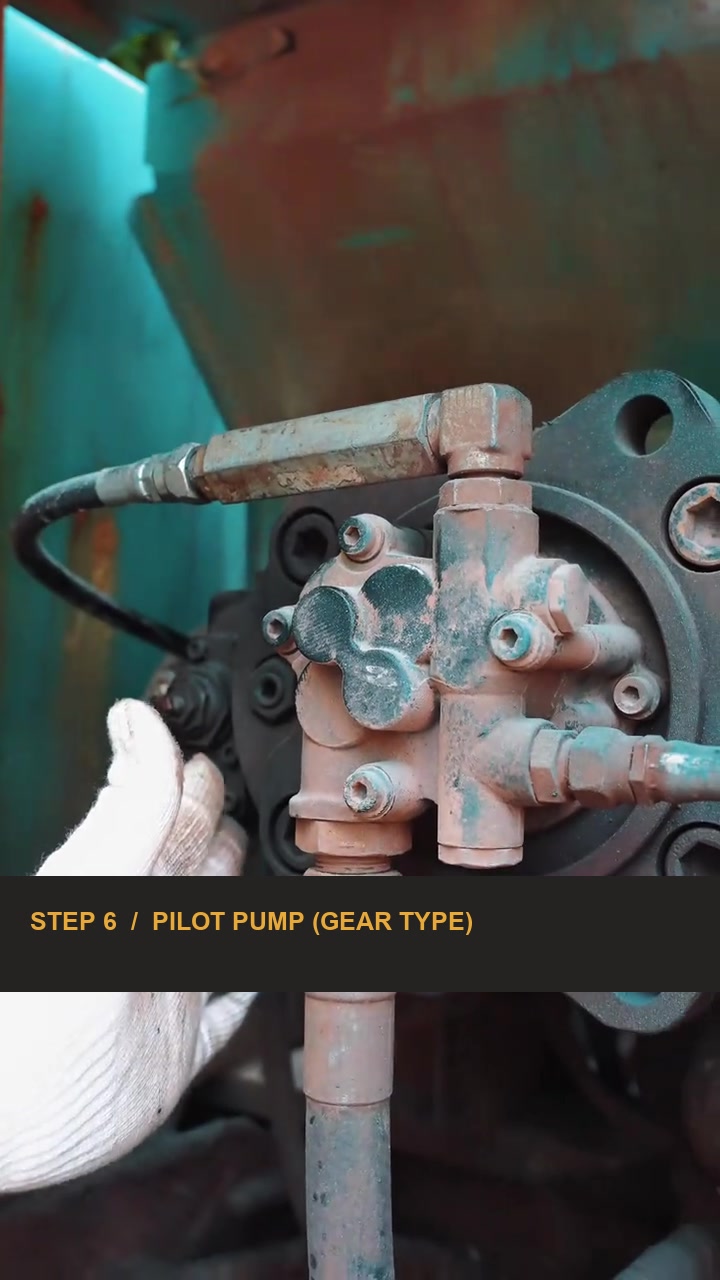
This is one place where the factory documentation and the field method agree exactly. The SK200-8 specification section lists two variable-displacement axial-piston pumps and one gear pump; the gear unit is the pilot pump. A machine can therefore have perfectly healthy main pumps and still be completely dead, because nothing is producing the low-pressure oil that moves the control valve spools. The same specification lists the control valve as a spool-type unit with 8 sections — every one of those spools needs pilot oil to shift, which is why losing one low-pressure supply kills all functions at once.
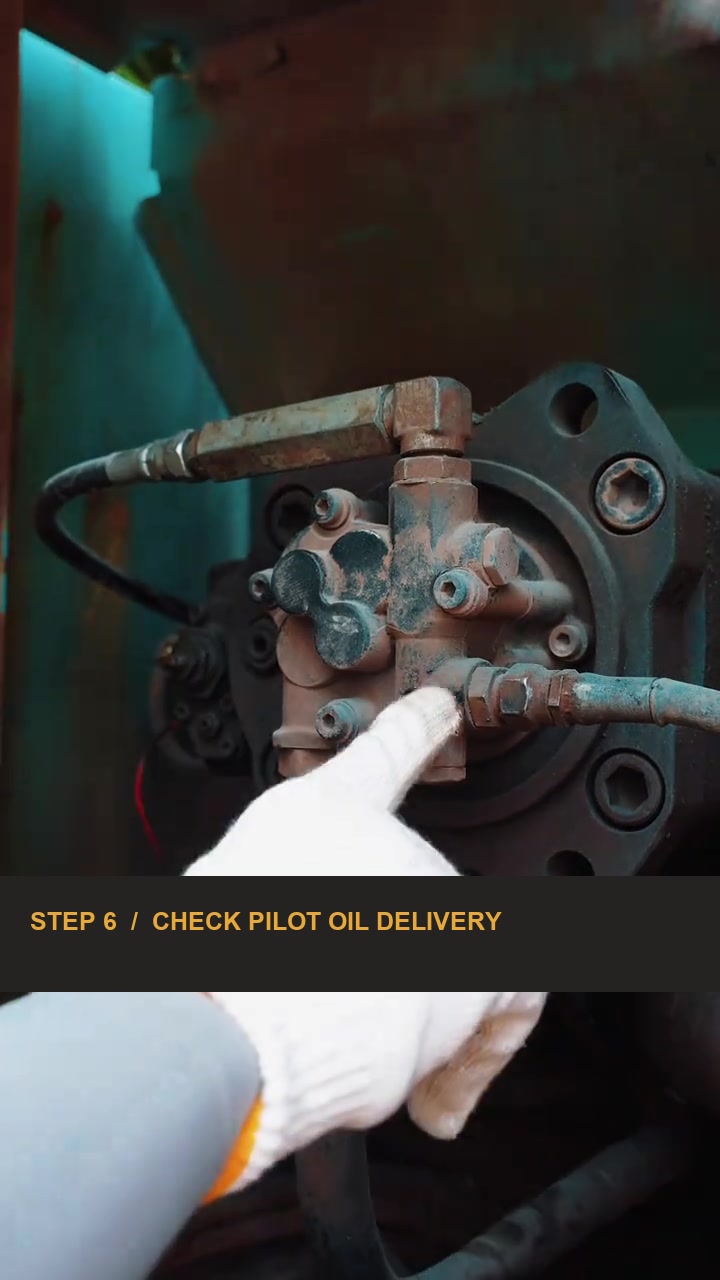
The field check is to disconnect the pilot delivery line at a suitable test point, contain the oil properly, start the engine briefly and observe the flow:
Good, steady oil delivery → pilot supply is present. Look downstream: pilot filter, pilot relief valve, or the main control valve and main pump.
Little or no oil → the pilot pump is not delivering. Suspect the pump itself, its drive coupling, a blocked pilot filter or a relief valve stuck open.
A sudden total loss on a machine that was working normally points at the coupling or a stuck relief before the pump itself; a gradual loss that gets worse as the oil warms up points at pump wear. Confirm with a pressure gauge against the specification for your model — see step 4 of our instrument-based guide.
Part number commonly listed for the SK200 pilot pump: YN10V00014F1 — pilot pump, SK200.
What each test proves — and what it does not
| Test | What it proves | What it does not prove |
|---|---|---|
| Two beeps from the monitor | The controller received and issued the unlock command | That the solenoid energised or that pilot oil is present |
| Fuse inspection / replacement | The supply to the unlock circuit is intact | Why the fuse blew, if it blew |
| Jumping the switch wires | The switch or its linkage is at fault when beeps return | Switch contact resistance, or that the linkage is safe to keep |
| Relay swap | The relay is at fault when beeps return | Coil condition, supply voltage elsewhere in the box |
| Connector swap 1 ↔ 3 | Whether the fault is the valve or the harness | The coil resistance; a stuck spool can look electrical |
| Manual override | The hydraulic side downstream of the valve can work | That the machine is safe to operate — it is not |
| Pilot line flow check | Whether pilot oil is being produced | Pilot pressure, relief setting or pump wear under load |
Swap and bypass tests are binary: they localise a fault, they do not size it. Close every diagnosis with a measurement — coil resistance, supply voltage and pilot pressure — and a re-test under the same conditions that produced the complaint.
Parts commonly involved
| Component | Commonly listed number | Where to check |
|---|---|---|
| 10 A safety lock fuse | YN24E00016S006 | Fuse product page |
| Safety lock limit switch | YN50S00041F1 | Limit switch product page |
| Safety lock solenoid, position 1 | YN35V00050F1 (KWE5K-31/G24DB50) | Solenoid valve product page |
| Pilot pump | YN10V00014F1 | Pilot pump product page |
These are catalogue references, not numbers printed in a service manual — service manuals list figure and illustration numbers, not sales part numbers. Generation, factory and serial number can change the correct number for the same component name. Send us the model, the serial number, a photo of the nameplate and a photo of the old part's connector, and our engineers will confirm the replacement before you order.
Frequently asked questions
Why is there no fault code when my Kobelco won't move?
Because the controller monitors the safety lock lever switch as an input, not the hydraulic output of the downstream solenoid valve. When the position-1 safety lock valve fails, the controller still sees a valid "lever down" signal and logs nothing. The machine simply goes dead. The service manual handles this kind of failure through its symptom-based diagnosis branch, not its diagnostic-code branch.
Can one solenoid really stop every function?
Yes. The safety lock solenoid gates pilot oil to the joysticks. Pilot oil is what shifts the main control valve spools, so if that gate stays closed there is no boom, arm, bucket, swing or travel — even with healthy main pumps and a healthy engine. It is the classic reason a dead machine gets blamed on a pump it does not need.
What does an F033 code mean after swapping connectors?
A code such as F033 appearing after the position-1 and position-3 connectors are exchanged indicates that the controller has detected the moved channel and points at the solenoid as the suspect. On SK200-8 eight-solenoid blocks, F033 is commonly associated with the travel-speed solenoid position. Code assignments vary by model variant and serial number, so read the code against your own machine's manual. What matters is the pattern: a code appearing after a swap tells you the controller has detected the moved channel; no code and no movement points at the harness.
Is it safe to run the machine with the solenoid override engaged?
No. Depressing the override pin holds the pilot circuit permanently open, so the machine will move even with the safety lock lever raised. Treat it as a short diagnostic confirmation or a way to reposition a stranded machine only, with the area clear. Replace the faulty valve, restore the pin and verify the lock lever cuts all functions before returning the machine to work.
How do I tell a pilot pump failure from a main pump failure?
Check pilot oil delivery first. Good flow with all functions still dead moves the investigation downstream to the pilot filter, relief valve or control valve; no flow points at the pilot pump, its drive coupling or a stuck relief. A main pump failure normally leaves some functions working or announces itself with noise. Confirm with a pilot pressure gauge against your model's specification.
Is the J05E engine causing the problem?
Almost certainly not. On the SK200-8 / J05E-TA combination covered here, the engine starts and runs normally throughout this fault. The entire failure sits in the machine's safety lock and pilot circuits, which belong to the excavator, not the engine. The J05E engine manual is useful here only because it describes a four-step diagnostic method. Engine complaints — white smoke, loss of power, hard starting, stalling under load — need a different guide.
Will these steps work on my machine?
The sequence is documented on a Kobelco SK200-8 with the Hino J05E-TA and applies most directly to the SK-8 family; the factory manual covers SK200-8 and SK210LC-8 together. Later generations use different solenoid valve families and code assignments, and other brands use different names for the same parts (gate lock lever, pilot cut-off solenoid, PPC lock). The logic transfers; the positions, codes and part numbers do not. Check the nameplate and serial number first.
Related reading and next step
Kobelco Excavator Won't Move: 4 Checks Before a Mechanic — the instrument-based version of this diagnosis, with coil resistance and pilot pressure checks.
What the 10 A fuse protects and the fuse box layout — for tracing the unlock circuit properly.
Not sure which solenoid position or part number your machine uses? Send the model, serial number, hour meter reading and a photo of the nameplate and the old connector. Our engineers confirm the replacement list before quoting.
Sources and verification
Field procedure: compiled by the BNR Technical Team from field service practice on Kobelco SK-8 machines. The beep test, wire bypass, relay swap, 1↔3 connector swap, manual override and pilot line flow check are documented no-instrument triage methods for a machine that starts normally but has no hydraulic response. The sequence is written for a Kobelco SK200-8 with the Hino J05E-TA engine; that configuration is taken from the SK200-8 factory specification section.
Factory documentation: Kobelco SK200-8 / SK210LC-8 service manual S5YN0119C01 — specification section 2.5 (Hino J05E-TA, pump configuration, 8-spool control valve, serial-number versions) and chapter 47 (fault maintenance organised by symptom). Hino J05E service manual — four-step fault analysis method. Engine specifications in this article are quoted from the SK200-8 machine manual, not from the forklift-application J05E engine manual. Manual section references are internal working notes.
Part numbers: BNR parts catalogue pages linked above. Service manuals do not list sales part numbers; every number here must be confirmed by model and serial number.
Code assignment:
F033is a commonly cited code for the travel-speed solenoid channel on SK200-8 eight-solenoid blocks, cross-checked against publicly available references. It is not presented as a factory-confirmed mapping for every serial range; confirm against your own machine's manual.
Reviewed by the BNR Technical Team, 11 November 2026.
Disclaimer
This article is general technical information for qualified service personnel, not a substitute for the service manual for your specific machine. Working on hydraulic and safety-lock circuits carries a risk of serious injury. BNR Excavator Parts is an independent parts supplier and is not affiliated with or endorsed by Kobelco Construction Machinery Co., Ltd. or Hino Motors, Ltd. All brand names, model designations and part numbers are used for identification and fitment reference only.
Not sure which part fits your machine?
Send the model, serial number, hour meter reading and a photo of the nameplate and the old connector. Our engineers confirm the replacement list before quoting.
Request a part number check