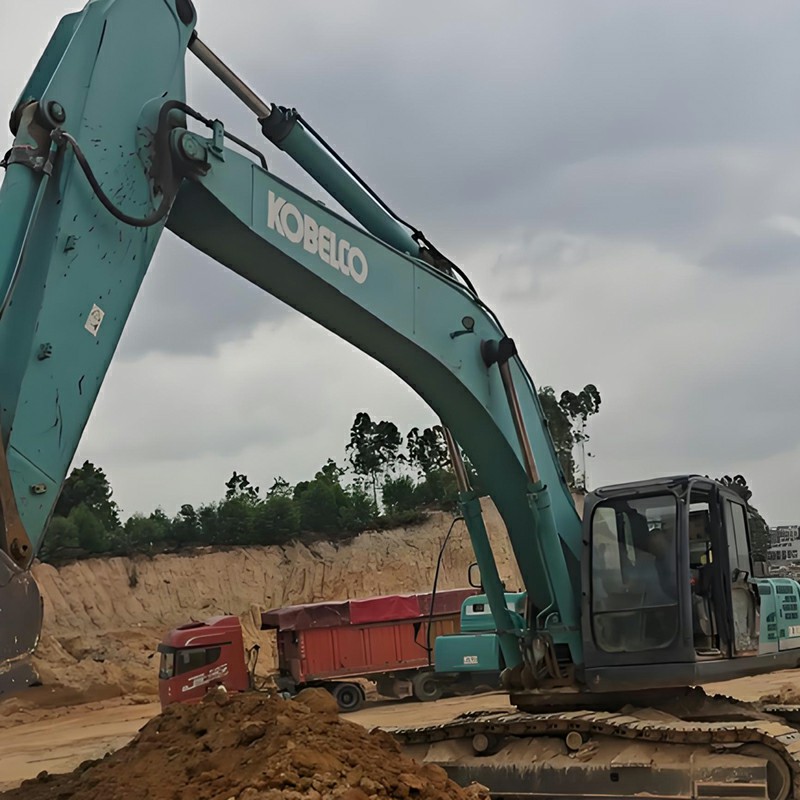
A machine with 323 hours on it — barely past its first services — came in with three complaints that do not usually belong together: white smoke from the exhaust, no power, and a boost pressure alarm that appeared for a moment and then went away.
It was the turbocharger. Below are the questions that came up during the diagnosis, in the order they came up.
What were the symptoms?
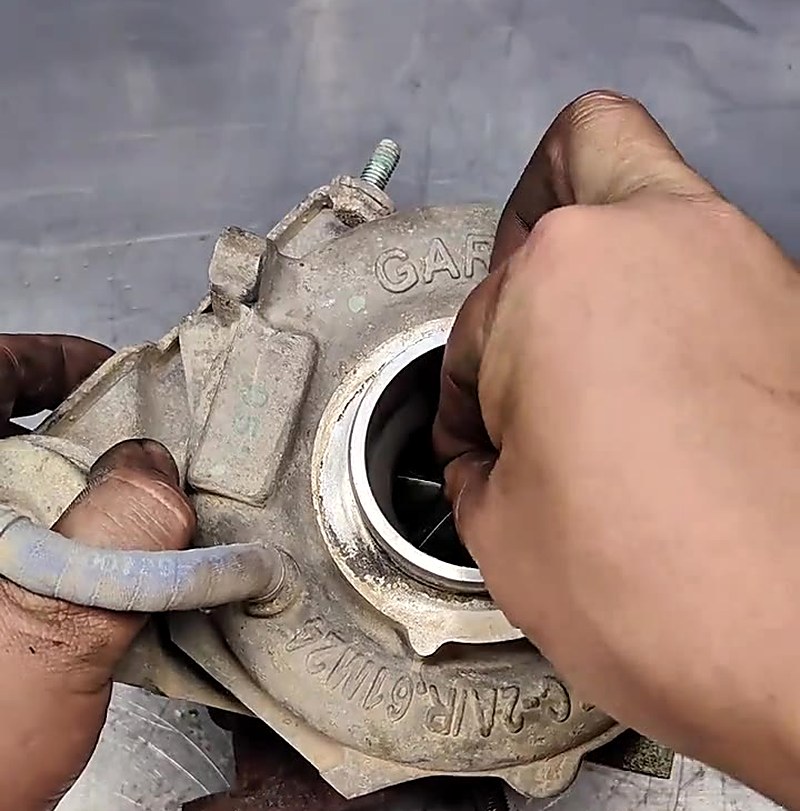
Three things, reported together:
White smoke from the exhaust — continuous when working, not just at start-up.
No power — the machine would move but nothing felt normal.
A boost pressure sensor alarm that lit for a second and cleared itself. By the time the operator looked again, it was gone.
On its own, an alarm that clears itself is easy to dismiss. Combined with white smoke and no power, it is a clue about severity: something is failing, but not yet completely.
Why did the alarm only appear for a moment?
Because the damage was not severe enough to pull boost below the alarm threshold at part load.
Boost pressure rises with engine load. At idle and light work, the turbo still made enough pressure to keep the sensor quiet. Only at full load — where the ECU expects maximum boost — did the reading fall short, and only then did the alarm trigger.
This is the single most misleading thing about early turbo failure: an intermittent alarm is not an intermittent fault. The alarm is intermittent because your test conditions are. A machine that alarms only at full load has a fault that is already there at every other load, just below the threshold.
Why white smoke instead of blue?
Burning oil normally shows as blue-grey. This machine showed white — and the reason is worth knowing, because colour is the weakest part of exhaust diagnosis.
Two things were happening at once. Oil was passing the turbo seal into the exhaust side and burning. And the fuel in this region is poor quality, which adds soot to the exhaust. Soot plus oil mist reads as white or pale grey to the eye, not blue.
If you diagnose by colour alone, you will look for a coolant leak that does not exist. The stronger evidence is elsewhere: oil level dropping with no external leak, oil in the intake or exhaust duct, and shaft play at the turbo.
How do you prove it is the turbo and not the head gasket?
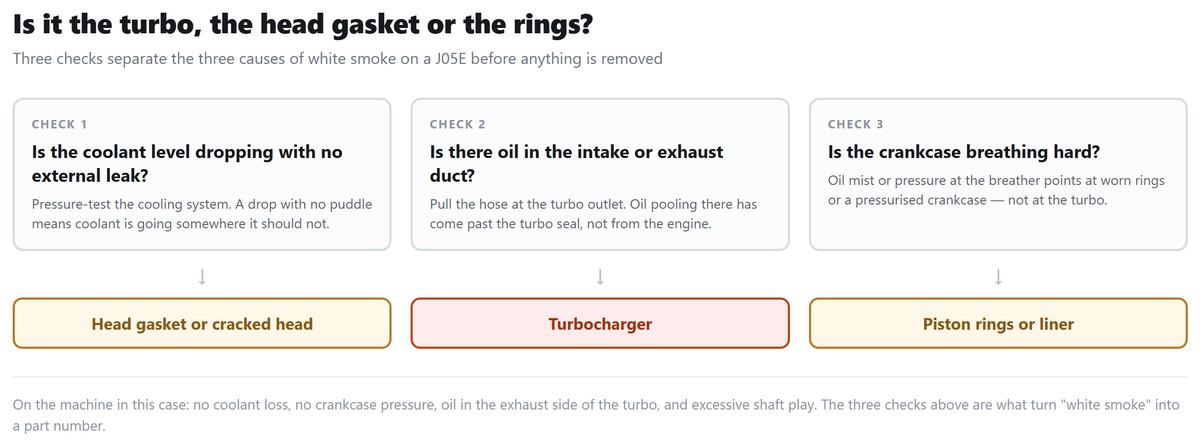
White smoke has three common sources on this engine: coolant, oil past the rings, and oil past the turbo seal. Three checks separate them, and none of them requires removing anything.
Coolant loss. Pressure-test the cooling system. A pressure drop with no external leak means coolant is entering a cylinder or an oil gallery — head gasket or a crack, not the turbo.
Crankcase pressure. Check the breather. Oil mist or pressure there points at worn rings or a pressurised crankcase. A healthy breather points away from the engine.
Oil in the ducts. Pull the hose at the turbo outlet and look inside. Oil pooling there has come past the turbo seal — it cannot come from the engine, because the intake is upstream of the engine.
On this machine: no coolant loss, no crankcase pressure, oil in the exhaust side of the turbo, and excessive shaft play. The first two checks ruled out the expensive possibilities before anything was unbolted.
What did the teardown show?
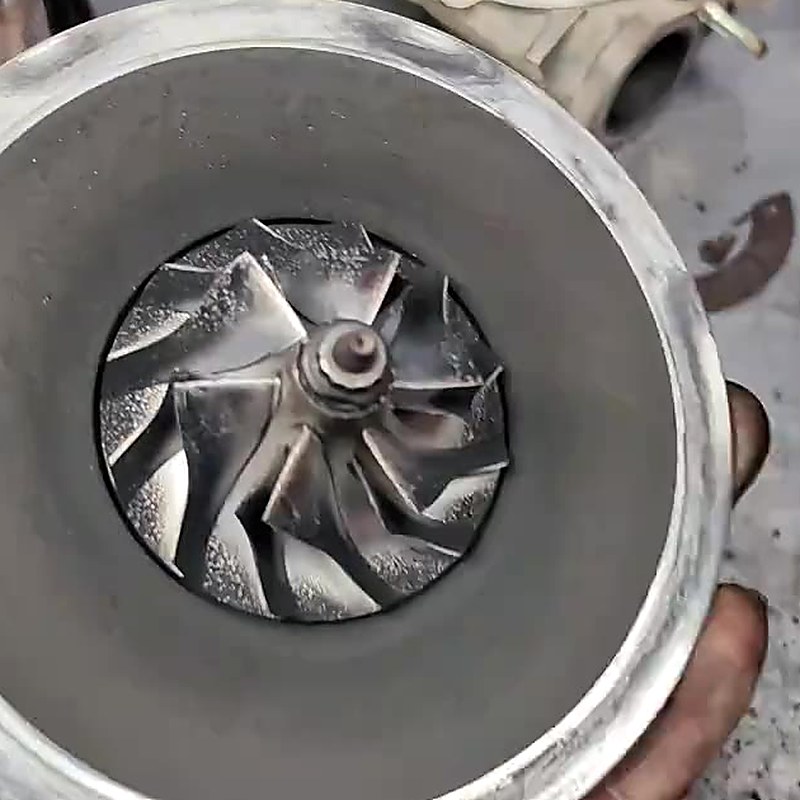
The compressor wheel — the intake side. Its blade edges are the first place to look on any short-life turbo: dust that gets past the filter hits these edges at full speed and rounds them off.
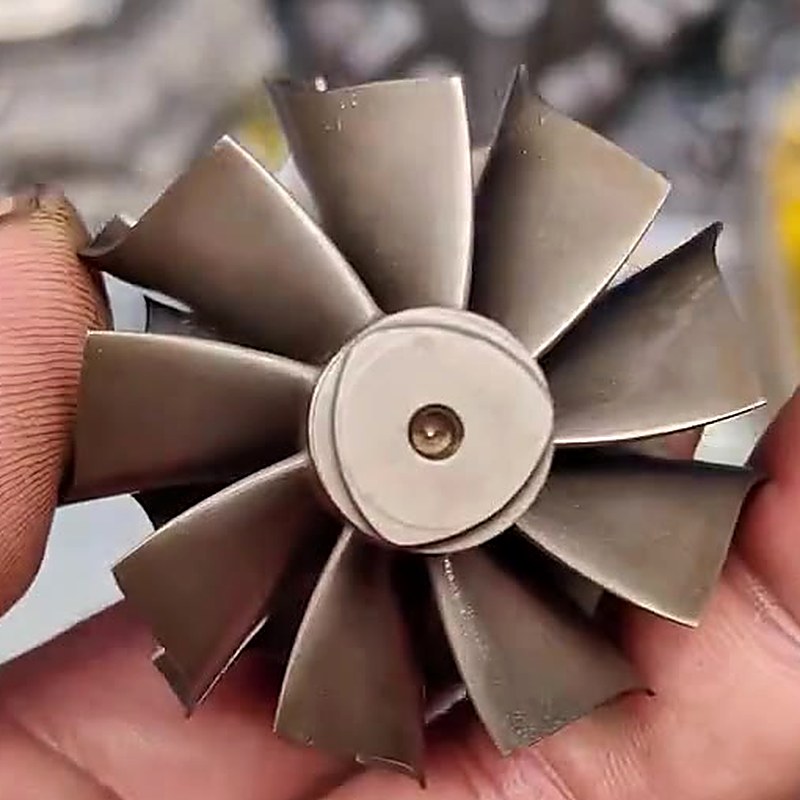
The turbine wheel — the exhaust side. It came out intact, which is consistent with the symptoms: the machine still ran and still made some boost. A broken wheel gives you a dead turbo and often engine damage, not white smoke and a flashing alarm.
Oil in the exhaust side. That is the physical evidence behind the smoke: the seal let oil through, and the exhaust burned it.
Why did it fail at 323 hours?
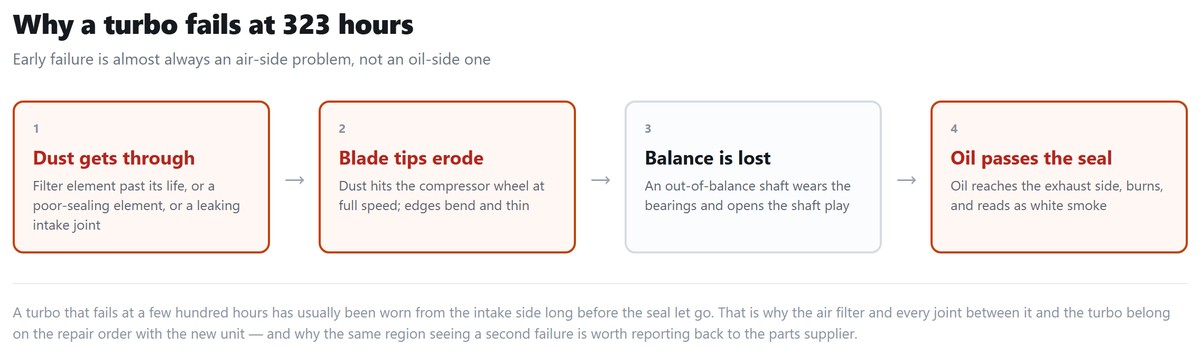
Three hundred hours is not a normal life for a turbo. Something shortened it, and there are two candidates worth taking seriously:
Air-side contamination. A filter element past its service life, an element that does not seal against its housing, or a joint between the filter and the turbo that is not airtight. Any of these lets dust through, and the chain in the diagram above starts. This is the more common of the two, and the cheaper to fix.
A defective unit. A wheel that is out of balance or cast badly will fail early regardless of how clean the intake is. This is the less common explanation, and the harder one to prove.
The way to tell them apart is the intake: if the filter and the ducting are clean and sealing properly, and the compressor blades show no erosion, the unit itself is the suspect. If the ducting is dusty or the element is overdue, the intake caused it — and the replacement will fail the same way unless the intake is fixed at the same time.
What has to be replaced with the turbo?
Fitting a new turbo into a dirty intake is how the second failure happens. The repair order should include:
The air filter element — and check that it seals against the housing, not just that it is new.
Every joint between the filter and the turbo — a cracked hose or a loose clamp lets dust past a perfectly good filter.
Engine oil and filter — the oil feed to the turbo is also the oil that lubricates the engine, and it has been carrying contamination.
The oil feed line — check it for restriction. A partially blocked feed starves the new bearings and produces the same failure in a few hundred hours.
How do you know the repair worked?
Three checks after the machine goes back to work:
Boost pressure at full load — compare against the specification, not against how it feels. This is the measurement that started the diagnosis; it should end it.
No smoke under load — white or black, at working temperature, with the machine actually loaded. Idling in the yard proves nothing.
Oil level after fifty hours — a level that holds confirms the seal is doing its job. A level that drops again means oil is still going somewhere.
The question we could not answer
The engineer who handled this case noted that it was the second turbo failure in the same region at low hours, and asked whether the cause was the blade or the intake.
From one machine, you cannot tell. Two failures in the same area is a pattern worth reporting — to the parts supplier, with the machine hours and the condition of the intake — because the answer changes what you sell: a turbo, or a turbo plus an air filter and a hose.
Parts involved
J05E turbocharger, VA241004631A · air filter, YN11P00072R100 · engine oil filter, VHS156072190
If the machine is smoking black rather than white, the cause is on the fuel side instead — start with black smoke and misfire on 10 series machines.
Note
This case is one machine at 323 hours. Boost specifications and turbo part numbers differ between J05E build years and between the 8 and 10 series — confirm against the serial before ordering, and check the cast number on the housing against the number in the parts book.