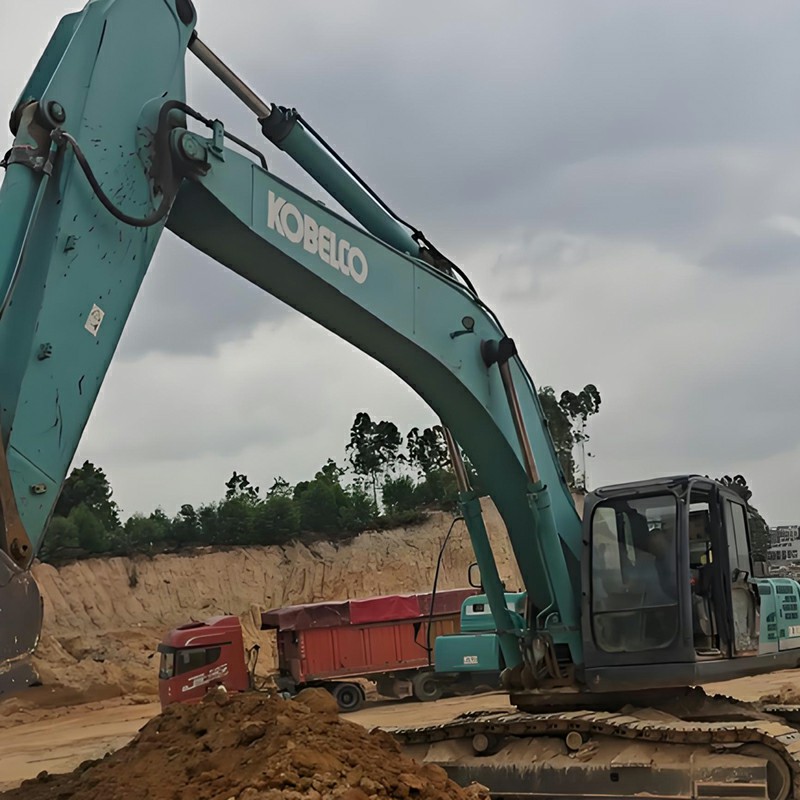
A 10 series Kobelco that smokes black and stumbles is usually not an air filter problem. On these machines the most common cause is one cylinder doing less work than the other three — and the controller will tell you which one before you lift a spanner.
Two checks do most of the diagnosis, and both are done from the monitor and the cab. Neither requires dismantling anything.
Why a single bad cylinder shows up as black smoke
Black smoke is fuel that did not burn. When one injector delivers poorly — dribbling instead of atomising, or delivering late — that cylinder's fuel does not burn properly, and the other three keep working normally. The result is a machine that smokes, loses power and runs unevenly, while the fault lives in one hole.
That is why the diagnosis is not "why is it smoking" but "which cylinder is not pulling its weight". The monitor answers the second question directly.
Method 1: read the cylinder compensation values
On 10 series machines the controller continuously balances the cylinders. If one is weak, the controller adds fuel to it and trims the others, and it stores that correction as a compensation value per cylinder.
Where to find it: the engine diagnostic screens on the monitor, the cylinder compensation (or injector correction) page. On most 10 series machines this is reached the same way as the other service screens — hold the buzzer stop switch and turn the key to ON, then page through to the engine section.
How to read it: with the engine warm and idling, all four values should sit close together, near the same baseline.
What a fault looks like: one cylinder reading far away from the other three. That cylinder is being compensated for because it is contributing less. The further it is from the others, the worse that injector or that cylinder is.
What it does not tell you: compensation values cannot separate a bad injector from low compression. Both make a cylinder weak; only the cut-out test below tells them apart.
Method 2: the stop-cylinder test
This is the oldest diesel diagnostic there is, and it still works: cut one cylinder at a time and watch what the engine does.
How to do it: with the engine idling at operating temperature, disable one injector at a time — through the diagnostic function on machines that support it, or by unplugging the injector connector. Note the change in engine sound, smoothness and smoke, then restore that cylinder and move to the next.
What the result means:
A working cylinder — the engine note changes clearly and it runs rougher when that cylinder is cut. It was contributing.
A dead cylinder — almost no change. Cutting it makes little difference because it was not doing any work anyway.
Smoke that disappears when you cut one cylinder — that is your culprit. The unburnt fuel was coming from that hole.
Do not run the test for long on one cylinder, and do not do it on a cold engine — cold combustion is rough enough to hide the difference you are listening for.
What to check before either test
The two tests above assume the engine is getting air and fuel. If either is compromised, every cylinder looks weak and the results are meaningless.
Air filter. A restricted element makes all four cylinders smoke. Check it before blaming an injector — it takes a minute and it is the cheapest thing on the list.
Fuel quality and water. Water in the fuel produces misfire that comes and goes, and it will look exactly like a failing injector on the monitor.
Rail pressure. If rail pressure cannot hold under load, all cylinders suffer at once. A machine with low rail pressure behaves like four bad injectors, not one.
Turning the result into a repair
| Test result | Most likely cause | Next step |
|---|---|---|
| One compensation value far out; cut-out confirms that cylinder | Injector | Replace or service that injector |
| One cylinder dead on cut-out, compensation looks normal | Compression or valve | Compression test that cylinder |
| All cylinders weak, smoke at all loads | Air restriction or rail pressure | Air filter, then rail pressure test |
| Misfire comes and goes with no pattern | Water in fuel or wiring | Drain the separator, check the injector connector |
One injector failing does not mean the other three are healthy — but it does mean they are not the cause of this symptom. Replace what failed, then re-read the compensation values: they should return close together.
Injector for the J05E engine: VH23670E0050 — confirm the number against the machine's serial before ordering, since 10 series build dates vary.
Frequently asked
Can a bad injector really cause black smoke and not just a misfire? Yes. An injector that dribbles delivers fuel that never burns properly — that is black smoke. A badly worn one can produce both smoke and a misfire at the same time.
Do I need to replace all four injectors? If one has failed mechanically at low hours, no. If the set is well worn or the fuel has been contaminated, replacing as a set is usually the better economics — the others are the same age and will follow.
Is the cut-out test safe on a common rail engine? Cutting an injector electrically is normal diagnostic practice. What you should avoid is running the engine for long periods with one cylinder cut, or doing the test with the engine cold where you cannot judge the result.
What if the compensation values are all equal but it still smokes? Then the problem is common to all cylinders — air, fuel quality or rail pressure — not one injector. Go back to the checks above rather than replacing parts.
Parts in this article
| Item | Part |
|---|---|
| Fuel injector, J05E | VH23670E0050 |
| Air filter | YN11P00072R100 |
| Diesel filter | VH23390E0020 |
If the smoke is on an 8 series machine and there is no misfire, the checks are different — see black smoke on an 8 series: air, turbo, exhaust restriction.
Black smoke is a fuel problem — too much fuel for the air available. White smoke under load is a different fault with a different list of causes: see the J05E turbo that failed at 323 hours for how oil reaching the exhaust reads as white smoke.
NoteMonitor menu names and compensation thresholds differ between controller versions and build years. Use the values on your own machine as the comparison — the four cylinders should read close together — rather than a figure quoted from another machine.
When every cylinder passes the cut-out test and the smoke is still there, move back to the air side: the P0405 EGR isolation test covers the intake and EGR checks that apply before an injector or turbo is condemned.