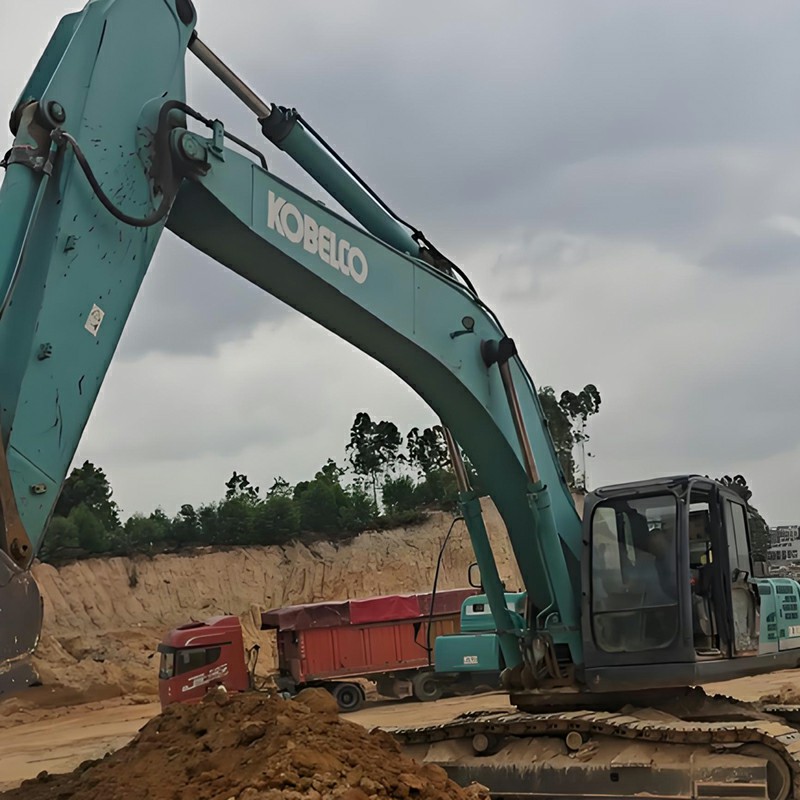
FIELD DIAGNOSIS / BLACK SMOKE / EGR & AIR SIDE
A Kobelco that pours black smoke under load is burning more fuel than the air reaching the cylinders can support. The usual advice is to check the air filter, then work through fuel delivery and hydraulic load. That order is right, but it leaves one expensive question open: is the air side actually the cause on this machine, or are you about to order a turbocharger the engine does not need?
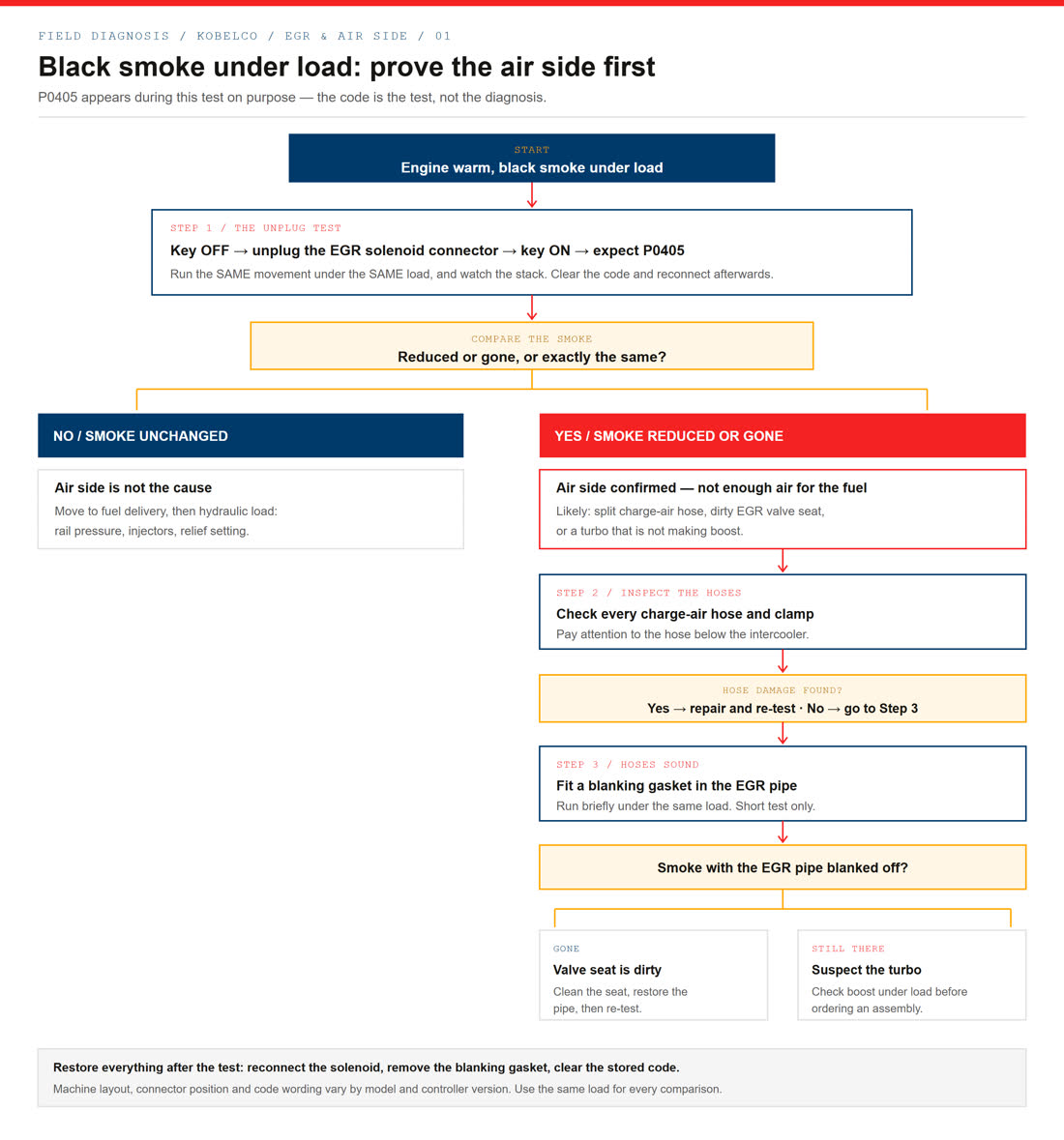
There is a field test that answers that question in about twenty minutes, with no scan tool and no new parts. You deliberately disconnect the EGR solenoid, let the controller log a P0405, and watch what the smoke does under the same load. If the air side is guilty, a blanking gasket in the EGR pipe then separates a dirty valve seat from a turbo that is not making boost.
This article covers that one test. The links near the end cover the rest of the fault list.
P0405 during this test is expected. On these engines P0405 is the EGR valve lift sensor 1 circuit low code. Pulling the solenoid connector opens that circuit, so the monitor logs the code. It is a reaction to what you just did, not a diagnosis and not a failed sensor. Clear it and reconnect the connector when the test is over.
What the test can and cannot tell you
It answers one question: does the smoke depend on the EGR and air side, or not? It does not name the failed part by itself, and it does not replace a boost measurement before condemning a turbocharger. Three conditions make the result worth trusting:
Engine at operating temperature, not cold.
The same movement, the same load and the same throttle position before and after every change.
A clear view of the stack in daylight, or a second person watching it while you operate.
Keep the test short, restore every connection afterwards, and never leave the machine working with the EGR pipe blocked.
Step 1 — Unplug the EGR solenoid and load the machine
Switch the key off, find the EGR solenoid connector on the engine and separate it. Switch the key back on. The monitor should now show P0405 (EGR valve lift sensor circuit low) — that is the expected reaction, not a new fault.
Start the engine and repeat the movement that produced the smoke: the same boom or travel function, the same load, the same throttle setting. Watch the stack, not the monitor.
Smoke reduces or disappears: the engine is short of air. Go to Step 2.
Smoke is unchanged: the air side is not the cause. Reconnect the solenoid, clear the code and move to fuel delivery and hydraulic load instead.
Step 2 — Check every charge-air hose, especially below the intercooler
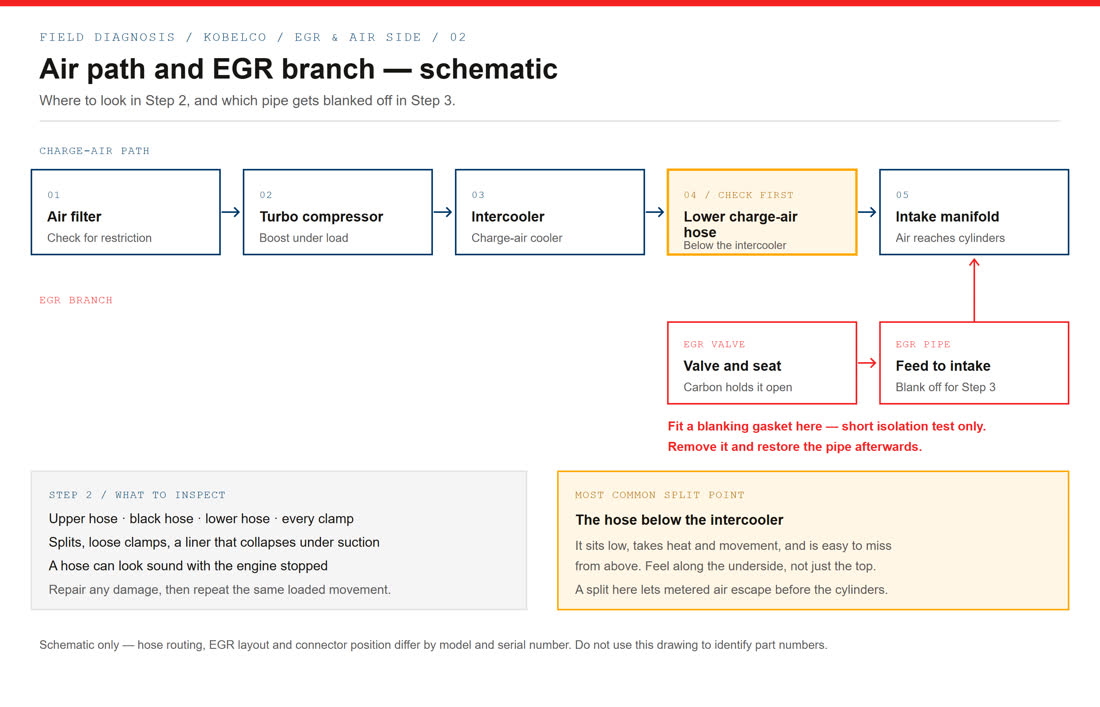
With the air side confirmed, inspect the whole intake path before touching the valve or the turbo: the upper hose, the black hose, the lower hose and every clamp. Look for splits, loose clamps and an inner liner that has started to separate. A hose can look sound with the engine stopped and collapse under suction as soon as the machine is loaded.
The hose that fails most often is the lower charge-air hose beneath the intercooler. It sits low, takes heat and movement, and is hidden when you look down from above. Feel along the underside with the engine off and the area clean.
If you find damage, repair or replace the hose and repeat the loaded movement. If the smoke clears, the job is done: reconnect the solenoid and clear the stored code. If every hose is sound, go to Step 3.
Step 3 — Blank off the EGR pipe
Make a blanking gasket from a suitable flat material and fit it in the EGR pipe joint, so exhaust gas can no longer reach the intake through that branch. Refit the clamp properly so nothing can leak or come loose.
Run the machine only long enough to repeat the same loaded movement. This is an isolation test, not a repair. Remove the gasket and restore the pipe afterwards.
No black smoke: the EGR valve seat is holding the valve open. Remove the valve, clean the seat and the valve face, refit everything and re-test.
Black smoke unchanged: the EGR branch is not the source. Check boost under load, then look at the turbocharger and the exhaust path.
Reading the result
| What you observed | What it rules in | Next action |
|---|---|---|
| Smoke unchanged after unplugging | Air side is not the cause | Move to fuel delivery, then hydraulic load |
| Smoke reduced, split hose found | Charge-air leak | Replace the hose, reconnect, clear the code, re-test |
| Smoke reduced, hoses sound, blanking removes smoke | Dirty EGR valve seat | Clean the seat and valve face, restore the pipe |
| Smoke reduced, hoses sound, blanking changes nothing | Low boost on the turbo side | Measure boost under load, then inspect the turbo and exhaust |
Before ordering a turbocharger, confirm boost under load and check the exhaust for a restriction. A turbo that is not making boost and a blocked exhaust both leave the cylinders short of air, and neither is fixed by cleaning the EGR seat.
Where this test fits with the other causes of black smoke
Black smoke has a short list of causes: air supply, fuel delivery and hydraulic load. This test is a fast way to decide whether the first one is worth chasing. If the test says no, skip the air side and go straight to the other two.
Full order of checks on an 8 series machine, air then rail pressure then hydraulics: black smoke on an SK260-8 with the J05E.
Uneven smoke, misfire or one weak cylinder on a 10 series: injector diagnosis and the cut-out test.
Weak power together with black smoke at every load: the four-step check.
Other EGR and engine codes on this controller, including P0405 and P0406: the Kobelco fault code index.
Parts that are often needed after this test
| Part | When the test points at it | Part number |
|---|---|---|
| Air filter element | Restriction found before the isolation test | YN11P00072R100 |
| Turbocharger hose | Lower charge-air hose is split or collapsed | YN11P01118P1 |
| Turbocharger, J05E | Boost is low and the EGR branch is clean | VA241004631A |
Send the model and serial number with any enquiry. Air-side parts change with build year, and the badge on the machine is not enough to confirm a number.
Questions we are asked
Does P0405 mean the EGR position sensor has failed?
Not when it appears immediately after you unplug the solenoid. The open circuit is what produced that code. A genuine sensor fault stays after the connector is back in place and the code is cleared.
Can the EGR pipe stay blanked off?
No. It is a short isolation test. Restore the pipe and the connector before the machine goes back to work.
The smoke reduced but did not disappear. What now?
Treat that as a positive result and keep going: inspect the hoses first, then blank the EGR pipe. Partial improvement usually means more than one restriction — a dirty air filter plus a leaking hose, for example.
Should the turbo be replaced as soon as blanking changes nothing?
Check boost under load first, and inspect the charge-air and exhaust paths. Order the assembly only after those checks point at the turbo.
Still smoking after the air-side checks?
Send us the model, serial number and operating hours, the codes on the monitor, the smoke colour under load, and the results of the unplug test and the hose inspection. A photo of the intake hoses and the EGR pipe helps us confirm the right part before you order a turbocharger.
Send the test results for a part checkInclude the part numbers you are comparing, if you already have them.