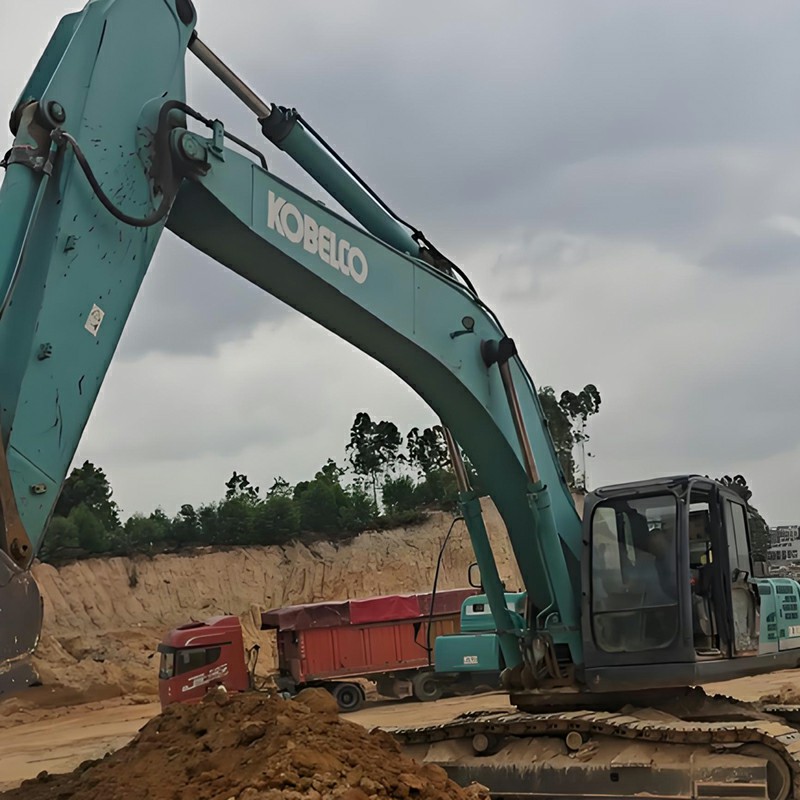
Black smoke is diesel that went into the cylinder and did not burn. Either the engine is getting more fuel than the air can burn, or the fuel is not being atomised properly. Those two sentences cover almost every case, and they also explain why the diagnosis has an order.
The order below is air first, rail pressure second, hydraulics last — cheapest and fastest first, most expensive last. On a Kobelco SK260-8 with the J05E engine it will take about an hour to work through, and it will tell you which of the three systems is responsible before any part comes off.
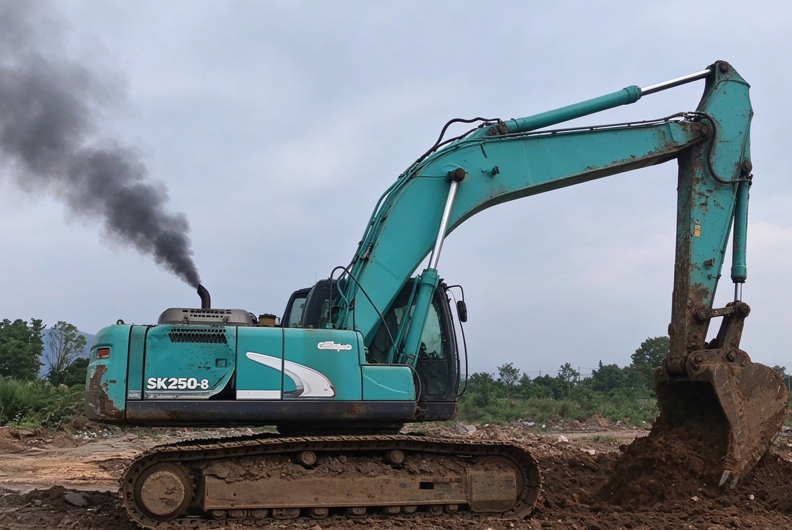
Machine under load, black smoke from the stack
Step 1 — air: the cheapest thing to check
Before touching anything electronic, confirm the engine can breathe. A restricted air filter, a collapsed intake hose or a blocked intercooler does not just cost power — it leaves the fuel unburned and puts it out of the stack as black smoke.
Replace or clean the air filter element, check the intake path for anything collapsed or blocked, then load the machine again and watch the stack. Smoke that reduces or disappears confirms the intake was the restriction. Smoke that stays exactly the same means the air side is fine and you move on — you have lost ten minutes, not a day.
There is a second intake-side cause that gets missed: the EGR valve. A valve stuck open dumps exhaust gas into the intake when the engine is already short of air, which produces exactly the same rich mixture and the same black stack. On this engine family the EGR side has its own group of codes — the valve solenoid circuit, the valve position sensor, and a separate code for a valve that is stuck. If a code points at the EGR circuit, look at the valve mechanically, not only at the wiring.
Step 2 — rail pressure: is the fuel side delivering?
If the intake is clear, the next question is whether the injection system is doing what the ECU asks. Read rail pressure under load, not at idle — a pump that is tired will often hold pressure at idle and fall away the moment the machine starts working.
| Condition | Rail pressure on the monitor |
|---|---|
| SK260-8 / J05E, H mode full throttle | 115 – 120 MPa |
| J08 engine, under load (for comparison) | 130 – 150 MPa |
If rail pressure under load sits below the specification for your engine, the fuel side is not delivering. On a common rail Hino that narrows to two suspects: the injectors — worn nozzles, poor atomisation — or the SCV on the high-pressure pump, stuck or sluggish so the pump cannot build pressure.
The two behave differently. An SCV that sticks tends to make pressure fall away suddenly and sometimes recover on its own; worn injectors give a gradual loss, with smoke that gets worse as load rises. If rail pressure cannot reach specification at all, start with the SCV — it is the cheaper part and the more common failure.
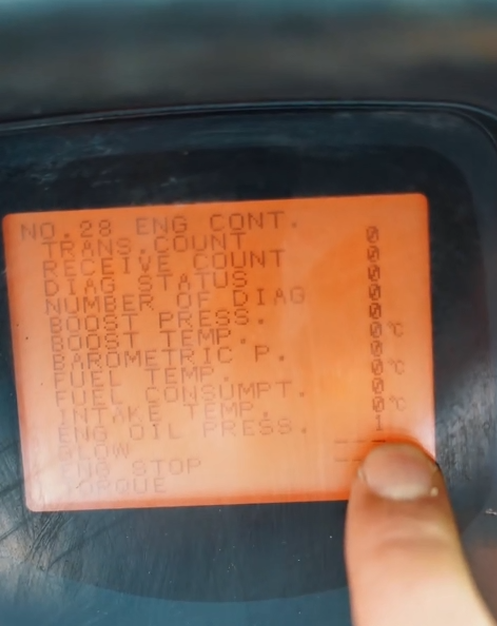
Monitor reading — rail pressure value, or the stored code list.
Step 3 — hydraulics: when the engine is being stalled
The third cause is not an engine fault at all. If the hydraulic system is loading the engine beyond what it can carry — a relief valve dumping, a circuit set too high, flow adjusted badly — the engine labours, the governor adds fuel, and the stack goes black.
The check is a stall test at low throttle. Bring a circuit against relief and watch what the engine speed does. Severe droop — the engine falling away much further than it should — points at the hydraulic side rather than the fuel side, and the fix is to check the relief setting and adjust flow rather than to keep replacing engine parts.
A machine can pass the air check and the rail pressure check and still smoke, because the extra fuel is being demanded by a hydraulic system working against a restriction it should not have.
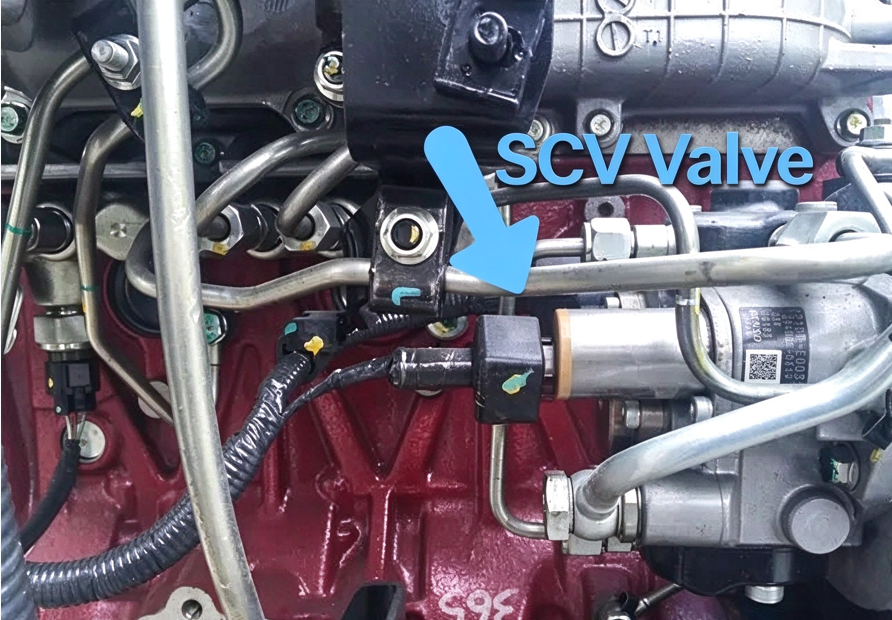
SCV on the high-pressure pump, or the EGR valve — whichever the fault turns out to be.
Why the order matters
1. Air filter first. Cheapest part, fastest check, and the most common cause of black smoke on a working machine.
2. Rail pressure second. One number on the monitor tells you whether the fuel side is capable or not. If it is below specification, no amount of air will fix the smoke.
3. Hydraulics last. Only after the engine can breathe and the injection system can deliver does it make sense to ask whether the machine is demanding too much.
Doing it the other way round — hydraulics first, or injectors first — is how a machine ends up with a new set of injectors and exactly the same black smoke.
What to record before you start
1. The stored codes. Codes narrow the search before any part comes off.
2. Rail pressure at idle and under load. Two numbers, not one. The gap between them is what diagnoses a tired pump.
3. Engine droop at stall. How far the rpm falls under hydraulic load separates an engine problem from a hydraulic one.
4. Whether the smoke changes with load. Smoke that appears only under load is fuel or air. Smoke at idle is usually injection quality.
Parts involved
Depending on which step finds the fault: the air filter element, the fuel filter, the SCV valve on the high-pressure pump, or the injectors.
If rail pressure turns out to be the problem, this case is worth reading next: an SK200-8 that would not rev because the SCV was mechanically stuck — no fault code, and the monitor showed pressure rising while a gauge showed it was not.
Note
Rail pressure figures, fault code definitions and stall test limits differ between engine models and ECU versions. The values above are what this machine's monitor showed — confirm the specification for your own machine in the engine service manual before condemning a part.