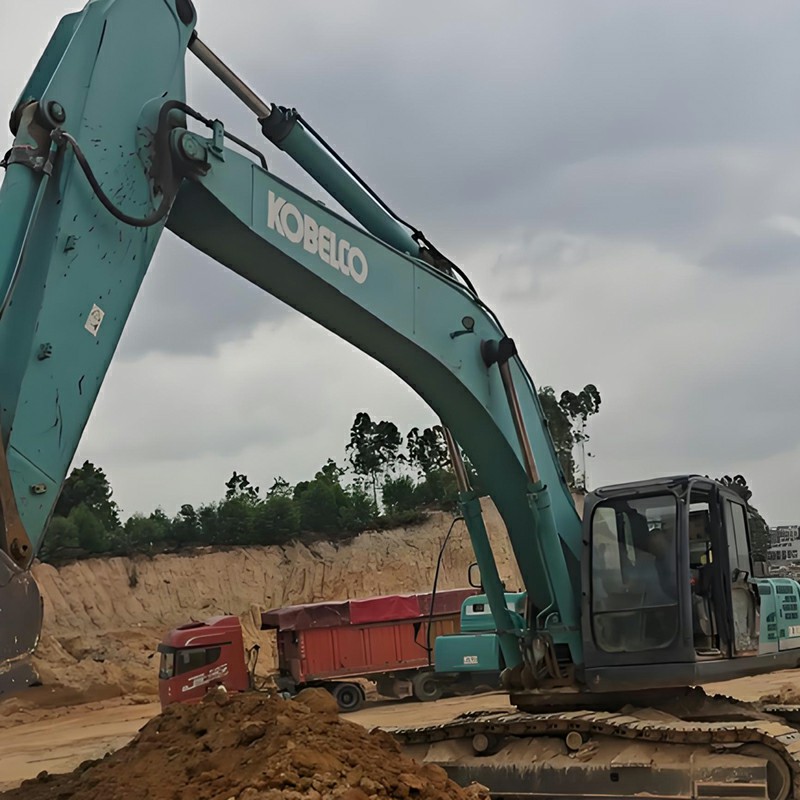
The starter cranked normally. The engine caught for a second, then died, and the monitor showed nothing. That was the first visit. By the time the machine left, three fault codes had appeared — and the part that finally fixed it was not the part any of them named.
This is a case involving an SK200-8 equipped with a Hino J05E engine: The starter motor turns but fails to start the engine; occasionally, the engine starts but immediately stalls; no trouble codes were found during the initial inspection.
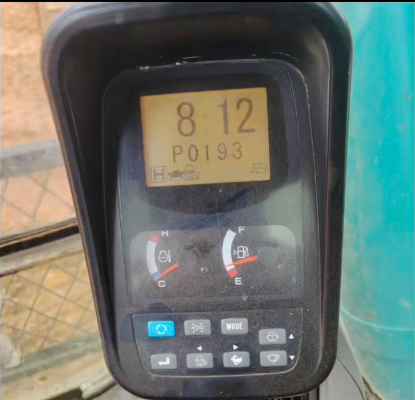
What the three codes actually mean
| Code | Circuit | What the ECU is reporting |
|---|---|---|
| P0183 | Fuel temperature sensor | Signal high — open circuit or reference lost |
| P0192 | Fuel rail pressure sensor | Signal low — short to ground or bad contact |
| P0193 | Fuel rail pressure sensor | Signal high — open circuit or reference lost |
Read that table again. P0192 and P0193 are opposite faults on the same sensor. A rail pressure sensor that has actually failed will normally set one of them and stay there. Getting both, hours apart, means the signal is intermittent — and intermittent signals live in the wiring, not in the sensor.
Then add P0183. Fuel temperature has nothing to do with rail pressure, yet both are complaining. When unrelated sensors on the same engine start throwing codes together, the common factor is usually the supply they share: the 5 V reference or the ground return.
Why the fuel filter was the wrong first move
The first visit replaced the diesel filter. It is a reasonable reflex — low rail pressure can come from a restricted filter, and a filter is cheap and quick. It also changed nothing.
A filter problem makes a machine worse under load. It does not make a warm engine start and then stall, and it does not come and go. The moment the symptom is intermittent, the fuel side is the wrong place to start spending.
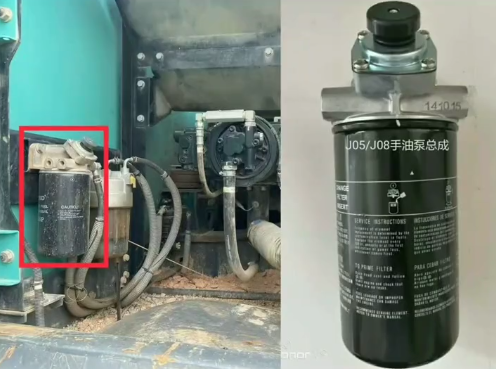
The filter was replaced on the first visit and changed nothing
The clue: touching the harness brought it back
While checking the rail pressure sensor circuit, the engine started running again after the sensor harness was disturbed. That single observation moved the case from "suspect the sensor" to "suspect the connection" — a mechanical action changing an electrical symptom is about as direct as evidence gets in the field.
From there the check was connector pins first, then the wire itself. Pins were clean. Flexing the loom while watching the meter told the rest of the story.
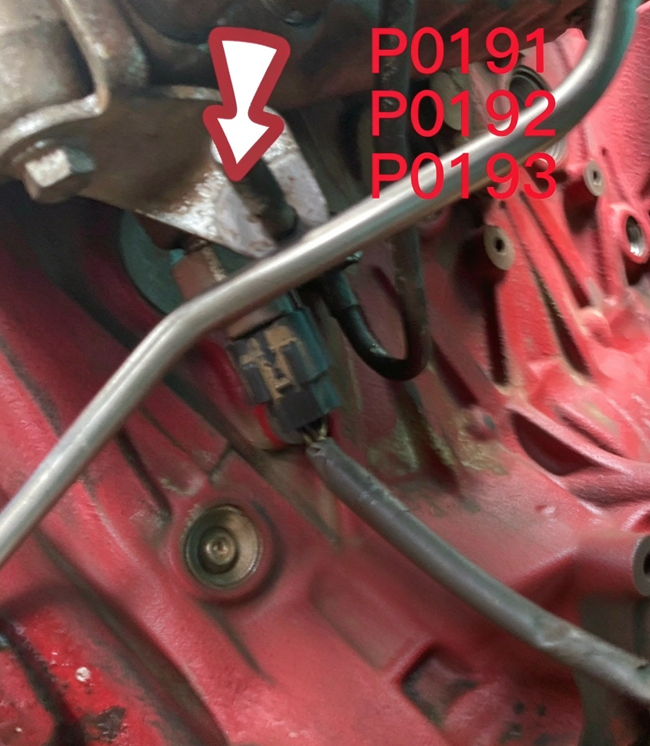
The rail pressure sensor connector. The pins were clean — the break was inside the loom behind it
The test that proved it
Key on, back-probe the 5 V reference at the rail pressure sensor connector, and watch the meter while you pull and flex the harness section by section, starting at the connector and working back toward the ECU.
On this machine the reading dropped by about 1 V when the loom was moved. A healthy reference sits at 5 V and does not move when you wiggle a wire. That 1 V drop also explains the code pattern: every sensor sharing that reference sees a lower supply, so rail pressure reads wrong, fuel temperature reads wrong, and the ECU sets whatever the corrupted values look like — low on one key cycle, high on the next.
The repair that did not hold
The damaged section was repaired, and the machine ran for about eight hours before the fault returned with P0192, P0193 and P0183 stored together. That is the signature of damage inside the loom rather than at the visible spot: the repair restored one strand, the rest of the conductor was already compromised.
On the third visit the J05E engine harness was replaced — the same harness listed as VH820649530A, VH82121E0G40 or VH82121E0G60 depending on the parts book. No further codes, no repeat stall.
What to check first next time
1. Read the stored history before touching anything. On the first visit this machine had already logged a W-code and P0193. The history is cheaper than a filter.
2. Never replace a rail pressure sensor on P0193 alone. P0193 means "signal high". That is as likely to be a broken wire as a dead sensor, and a broken wire is a fraction of the cost.
3. Treat opposite codes as a wiring case. P0192 and P0193 on the same machine, or a code that appears and clears on its own, points at the loom and the connectors.
4. Do the wiggle test with the meter connected. A visual inspection finds crushed wires. It does not find a conductor that is broken inside intact insulation — only a moving voltage does.
5. If a repair lasts hours, stop repairing. A second failure within a shift means the fault is distributed through the harness. Replace the section, not the strand.
Parts involved in this case
The harness that fixed it is the J05E engine wiring harness. It is listed under several part numbers depending on which parts book you are reading — VH820649530A, VH82121E0G40 and VH82121E0G60 are the same harness. The VH82121E0G40 / VH82121E0G60 harness is the one we stock, and it fits SK200-8 and SK210-8.
The rail pressure sensor and the fuel filter were both checked and left in place. Neither was faulty — the filter was replaced first and changed nothing, which on its own was the clue that the fuel side was not the problem.
If you are chasing the same codes, send us the machine serial and the stored code list and we will confirm the harness number against the parts book before you order. Other engine harnesses and rail pressure sensors for Kobelco are listed under excavator electrical parts.
Note on codes
P0183, P0192 and P0193 are engine-side codes from the Hino ECU, not Kobelco hydraulic codes. Definitions can differ between engine models and ECU versions — confirm them in the engine service manual for the machine you are working on. This article describes one SK200-8 and the fault that was actually found on it.