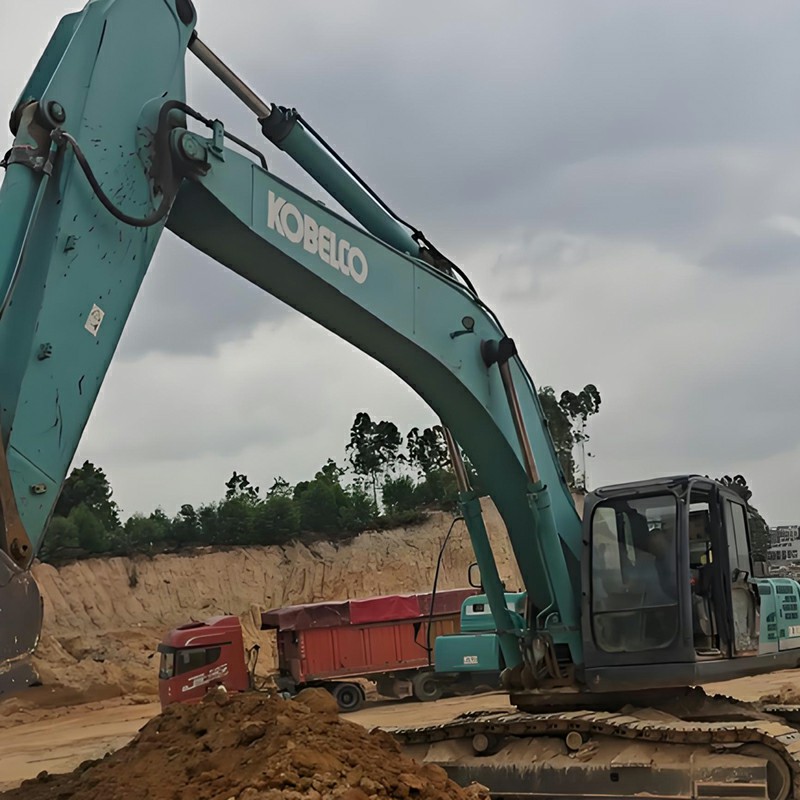
An SK200-8 comes in with C023 on the monitor and no power in the arm. The owner orders the sensor for the current SK200-12 — and the plug does not fit. That is how most people meet this part: after a code, holding the wrong number.
The Kobelco high-pressure sensor has been on these machines since the 6 series in 2002. The plug has changed twice, the part number four times, and only one number is still in production. Five minutes here tells you which one your machine takes, where it sits, and what to check before you buy.
Code starts with C → go to the two sensors on the pump, not the pump itself.
8 and 10 series share a plug — they swap directly.
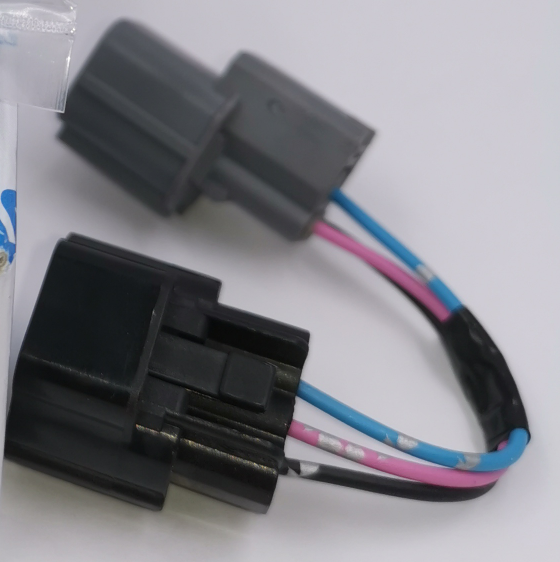
A 6 series needs the adapter to run the 10-series sensor.
Only YN52S00103P1 is still in production.
What the high-pressure sensor does
The sensor sits on the regulator of the main pump — one on P1, one on P2. It measures main hydraulic pressure and turns it into a voltage for the ECU, which uses the two signals for pump flow control, engine torque control and confluence control. Lose the signal and the ECU loses its reference: the machine gets slow and weak, and in bad cases drops into a protection mode.
One thing worth separating: the low-pressure sensor reads pilot pressure from the joystick — what the operator is asking for. The high-pressure sensor reads main pump pressure — what the machine is actually doing. Both fail with similar symptoms, so the first step is knowing which family the code belongs to.
Part numbers by generation: 6 to 12 series
| Series | Years | Part numbers | Plug | Status |
|---|---|---|---|---|
| 6 series | 2002 – 2007 | YN52S00027P1 YY52S00033F2 | Needs an adapter | Discontinued |
| 8 series | 2007 – 2015 | LS52S00015P1 YN52S00048P1 | Same as 10 series | Discontinued |
| 10 series | 2015 – 2022 | YN52S00103P1 | Standard | In production |
| 11 / 12 series | 2023 – | YN52S00103P1 | Standard | In production |
Kobelco introduced the 6 series around 2002, moved to the 8 series in 2007, launched the 10 series in 2015 and the 11 and 12 series in 2023. Exact start dates vary by region, but the plug changed three times over that run while the mounting position on the pump stayed the same.
If your parts book lists LS52S00015P1, YN52S00048P1, YN52S00027P1 or YY52S00033F2, the current replacement is YN52S00103P1 — plus the adapter on a 6 series. Whatever number you start from, the search ends at this one.

That gives three practical rules:
The 8 and 10 series interchange directly — same plug, it goes straight on.
A 6 series running the 10-series sensor needs the adapter — it will not plug in directly.
Only YN52S00103P1 is still in production. For an older machine the realistic route is the 10-series sensor plus the adapter.
The same generation can differ by tonnage and model year. The reliable method is to read the number on the old sensor itself, then compare the plug shape and the thread.
Where the sensor is located: P1 and P2 pumps
Every machine has two: one on the P1 pump regulator, one on the P2. Follow the main pump — it is the two-wire sensor screwed into the side of the regulator.
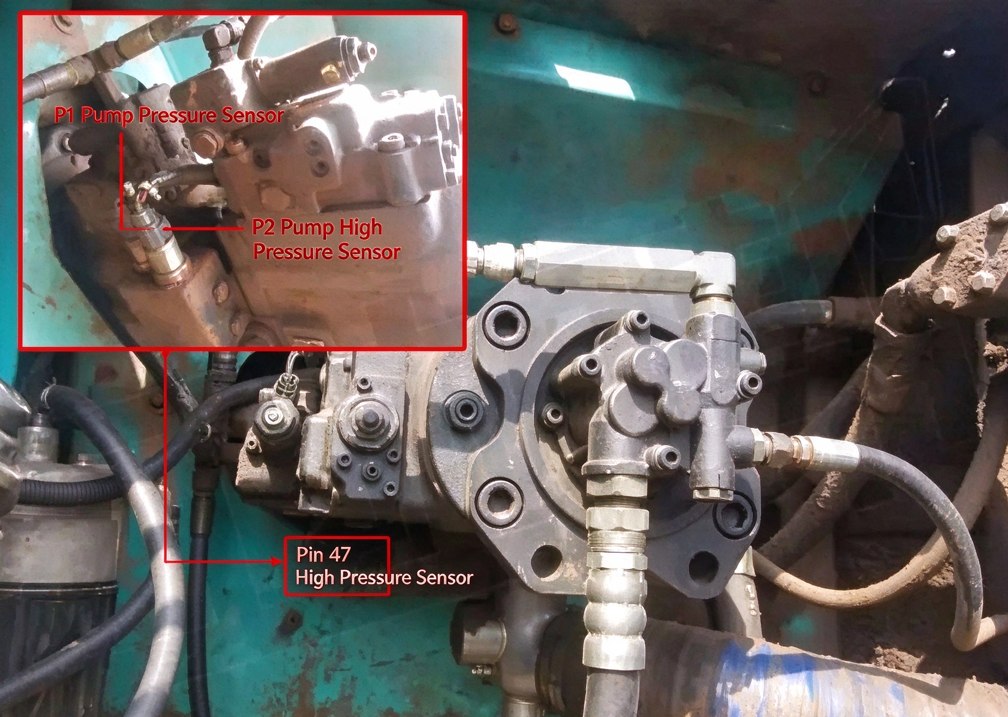
The two sensors on one machine are interchangeable. That is not just convenient for stocking — it is a diagnostic tool. Swap the two connectors and the fault either follows the sensor or stays where it was.
Fault codes: C012 to C024
These machines split high-pressure sensor faults into six codes, three per pump: abnormal output, open circuit, short circuit. As a rough filter, B codes usually point at the low-pressure sensors and C codes at the high-pressure ones — a C code sends you to the two pump sensors, not to the pump itself.
| Position | Abnormal output | Open circuit | Short circuit |
|---|---|---|---|
| P1 pump | C012 | C013 | C014 |
| P2 pump | C022 | C023 | C024 |
Each code has its own walkthrough in a separate article: resolving the C012–C024 high-pressure alarms. What follows is the order that applies to all six.
| Step | What to do | What the result means |
|---|---|---|
| 1 | Swap with the other sensor of the same type | Code changes to the other sensor → that sensor is faulty |
| 2 | Code stays, so check the harness and connectors | Poor contact, broken wire, water in the plug |
| 3 | Harness is good and the code remains | Suspect the ECU; retest after replacing it |
How to test it: the 1.4 – 4.7 V reading
Take C022. Hold the buzzer switch, turn the key to ON and open service diagnostic NO.7, option C-2, to read the P2 sensor input: 1.4 to 4.7 V is the normal band. Outside it, the signal itself is wrong.
If the voltage looks right but the code stays, swap the P2 plug with the P1 and read again — a code that moves is a sensor, a code that stays is in the harness at CN-140F or CN-103F.
Code definitions vary by model year and ECU version — confirm them in the machine's diagnostic manual, and finish the harness checks before condemning the ECU.
How to replace the sensor
Shut down, release hydraulic pressure, let the oil cool.
Clean around the sensor so nothing falls into the oil passage.
Unplug the connector, remove the hose, then unscrew the sensor.
Replace the O-ring — a flattened or hardened one will not seal again.
Fit the new sensor, torque it to spec, reconnect the hose and plug.
On a 6 series with the adapter, watch the orientation and sealing, and tie the loom so it is not under tension.
Start up, clear the code and re-check that the voltage is back in the 1.4–4.7 V band.
Which part number to order
6 series: the original number is discontinued. Use the 10-series YN52S00103P1 with the adapter — currently the only stable route.
8 series: same plug as the 10, so YN52S00103P1 fits directly, no adapter.
10 / 11 / 12 series: YN52S00103P1 straight out of the box.
Of the three numbers, only the YN52S00103P1 sensor is still produced — 0.2 kg, packed 10 × 10 × 5 cm. That is why older machines keep coming back to this one number.
One more thing: these sensors come in pairs. If one has failed, the other is the same age — replacing both saves a second breakdown on the other pump.
Frequently asked questions
Can an 8 series really take the 10-series sensor?
Yes. The plug is the same and it works straight away. Compare the thread and sealing face against the old part before fitting.
What happens if a 6 series runs without the adapter?
It will not connect properly, and an intermittent contact gives an intermittent signal. The adapter is not optional.
The code is still there after a new sensor — now what?
Check the harness at CN-140F / CN-103F before suspecting the ECU. Rule the wiring out completely first.
Why are the two sensors on one machine interchangeable?
They read the same main pressure to the same specification, one per pump. That is what makes the swap test valid.
Based on hands-on repair experience and the Kobelco service diagnostic procedure. It is a guide to fault direction, not a replacement for the factory diagnostic manual — code definitions vary by model year and ECU version, and harness checks come before replacing any major component.