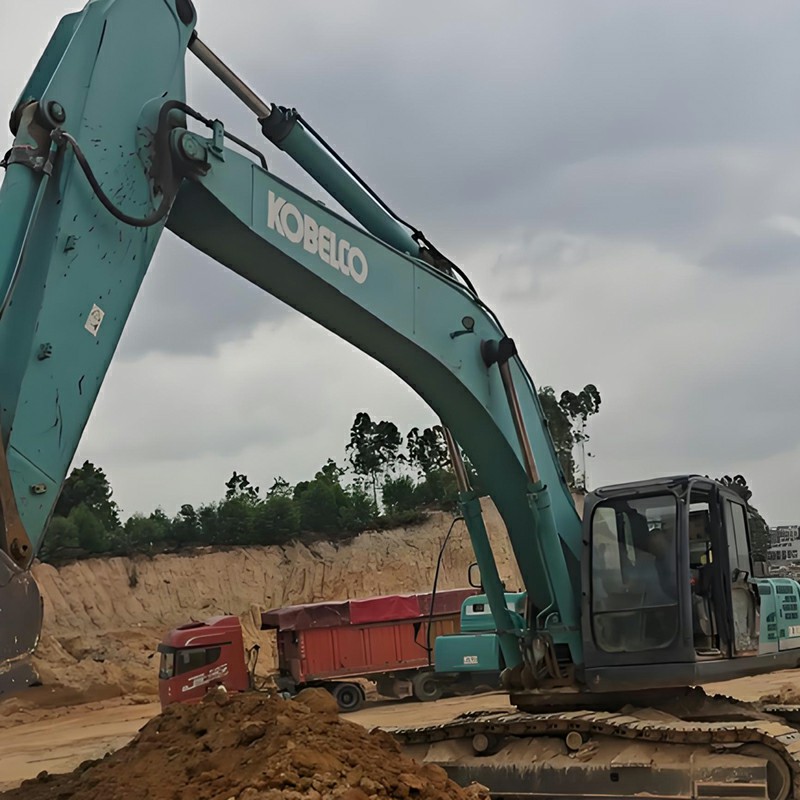
Kobelco 8-Series Excavator Operating TipsFour Switches, Four Expensive Mistakes
The swing parking brake, auto idle, the five-minute cool-down and the wiper button take up only a few lines in the manual — and they are the four most misused switches on a Kobelco 8-series machine. Each one is broken down into the short answer, the reason, the procedure and the usual mistake.
The Kobelco 8-series is one of the most familiar generations of excavator for operators in China, and its control logic is straightforward: what separates a profitable shift from an expensive one is rarely digging speed — it is whether a handful of switches were used correctly.
Leave the swing brake release switch in the wrong position and the machine can roll on a slope. Load a trailer with auto idle on and the engine lurches at the worst possible moment. Skip the five-minute cool-down and the turbo wears out early. Dry-wipe the windscreen and you score both the glass and the blade. The four sections below follow the operator's manual and real seat time; a cheat sheet, a troubleshooting table and eight FAQs follow at the end.
Swing parking brake: NORMAL versus RELEASE LOCK
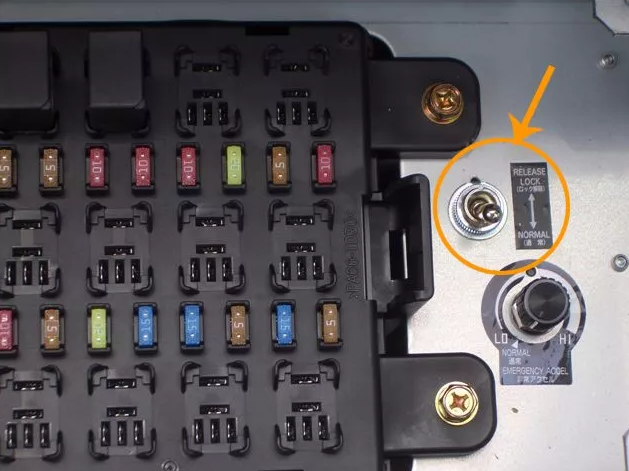
Leave it on NORMAL. Turn it to RELEASE LOCK only when the brake will not release and the machine has to be moved out of danger — then park, call service and switch back.
Why the switch exists
The swing parking brake is engaged by default: park the machine and the upper structure will not creep, even on a slope. The brake releases automatically whenever you swing or crowd the arm in — that interlock is by design, and needs no input from you.
So the switch is not a working-mode selector — it is a service bypass. It exists so that a machine with a stuck brake can still move out of a dangerous position.
The procedure
Confirm the brake is the problem: swing or crowd the arm and the upper structure still will not move.
Flip the toggle to RELEASE LOCK to force the brake open.
Move the machine to safe, level ground. Do not keep working.
Lower the bucket, move the safety lock lever to LOCK and shut down.
Call service, and return the switch to NORMAL once the fault is fixed.
In RELEASE LOCK the upper structure has no brake at all and can roll on a slope. It is a recovery measure, not a working mode; continuing to work in this state is how a stuck brake turns into an accident.
Common mistakes
Leaving it in RELEASE LOCK because "the swing feels smoother".
Forgetting to switch back, then discovering there is no brake on the next slope.
Treating a stuck brake as a hydraulic fault and working the levers repeatedly, which only adds heat.
Auto idle: when it must be switched off
Waiting for trucks, setting out, cleaning teeth: ON to save fuel and noise.
How it works
With auto idle engaged and the throttle dial above 1200 rpm, if no lever or travel pedal is touched for more than 4 seconds, engine speed drops to 1200 rpm. Any input returns it instantly to the dial setting. Press the switch again to cancel auto idle and hold the set speed — pressing it during a deceleration also brings the engine straight back up.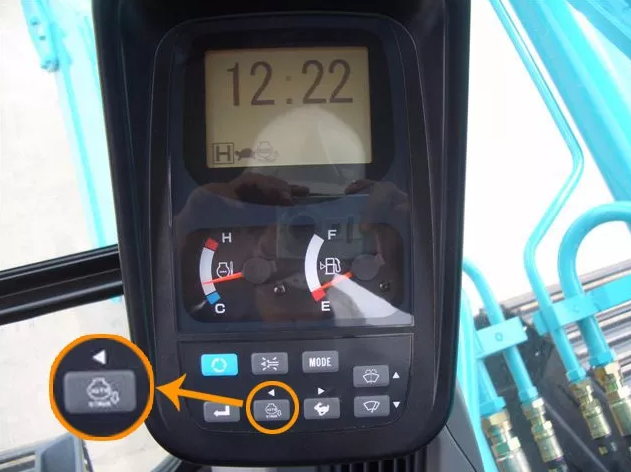
Fig. 2 — The auto idle button below the monitor. Press it, the indicator lights, and the engine drops to 1200 rpm after four seconds of inactivity.
On or off: a quick checklist
| Task | Auto idle | Why |
|---|---|---|
| Trailer ramps | OFF | Prevents the lurch at the ramp edge |
| Precision lifting / grading | OFF | Steady rpm keeps the motion predictable |
| Breaker work | OFF | Avoids rpm hunting between blows |
| Cleaning teeth, short stops | ON | No need to keep adjusting the dial |
Auto idle only works above 1200 rpm on the dial. If you are already running at low idle, the button makes no visible difference.
Shutdown: why the five-minute idle matters
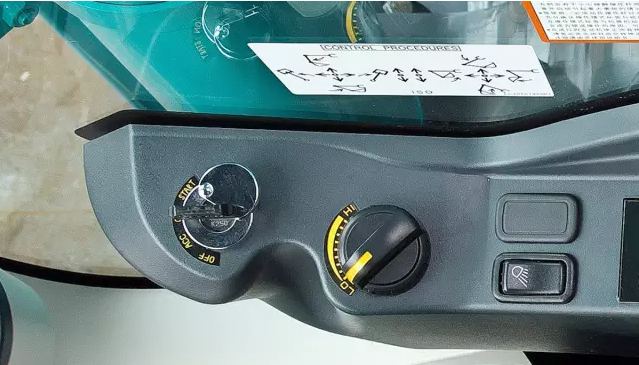
ower the attachment, lock the safety lever, turn the throttle to LOW, idle for 5 minutes, then switch off. Cutting oil to a hot turbo is what kills the shaft early.
Why a hot shutdown damages the turbo
A turbocharged engine's turbine can spin at over 100,000 rpm. Shut down straight from high load and the oil pump stops while the turbine is still spinning fast and hot: the shaft loses lubrication and cooling in the same instant. Do that habitually and the shaft wears early — followed by oil seepage, whining and eventually seizure.
Those five minutes are not about cooling the whole machine — they keep oil circulating, carry heat away from the shaft and let the turbine spool down gently. Skip them and nothing happens today; the bill arrives a few thousand hours later.
The five-step shutdown
;Lower the attachment to the ground.
Move the safety lock lever to LOCK.
Turn the throttle dial to LOW.
Idle for 5 minutes so the turbo, oil and coolant settle.
Turn the starter switch to OFF.
One: revving before shutdown — it only spins the turbo faster and hotter right before you cut the oil. Two: killing the key straight after heavy or hot work — even in a hurry, take the five minutes.
Wiper and washer: one button, three modes
One press is intermittent, two is continuous and three stops it. The washer is a separate button. Spray first on dried mud, and free a frozen blade before switching on.
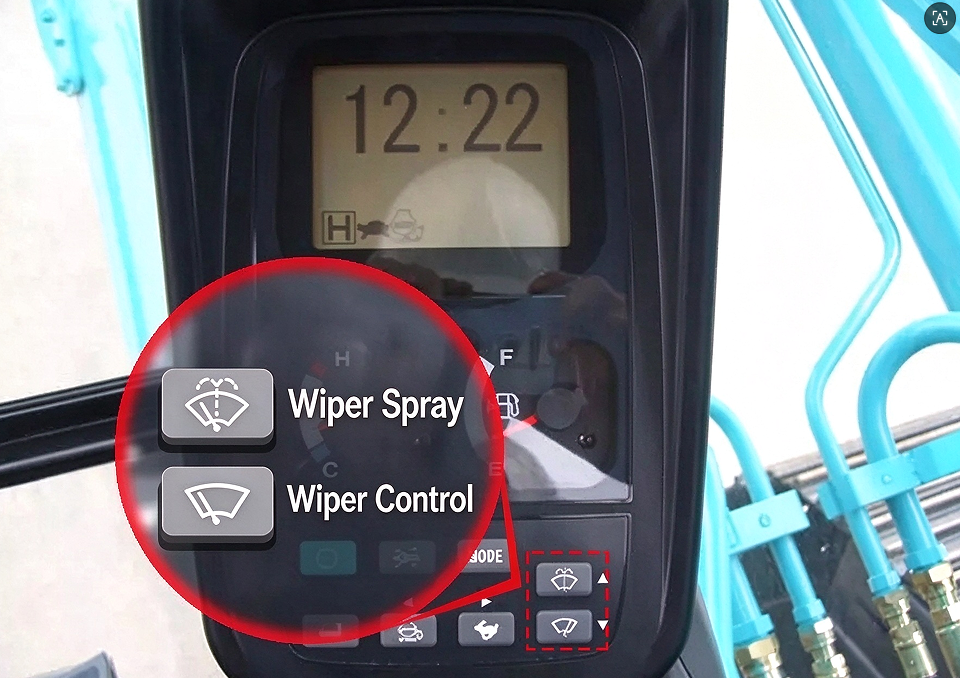
Two details most operators miss. First, never dry-wipe a layer of dried mud: spray first, or the grit works like sandpaper on both the blade and the glass. Second, in freezing weather free the blade before switching on — dragging it can blow a fuse or burn out the motor.
Cheat sheet: the right setting for each situation
| Situation | Switch | Setting |
|---|---|---|
| Normal work / parking | Swing brake release | NORMAL — brake engaged |
| Brake will not release | wing brake release | RELEASE LOCK, then park and repair |
| Trailer ramps | Auto idle | OFF — steady rpm |
| Stop-start work | Auto idle | ON — 1200 rpm after 4 s |
| Before shutdown | Throttle + key | LOW, idle 5 min, then OFF |
| Rain, fog, dust | Wiper button | intermittent / 2 continuous / 3 off |
Troubleshooting: five symptoms and what to check
This table does not replace a technician, but it helps you rule out "the switch is in the wrong position" before you call one — a fair share of on-site faults are really setup problems.
| Symptom | Likely cause | Action |
|---|---|---|
| Swing will not move | Brake stuck or release circuit fault | Brief RELEASE LOCK, then park and repair |
| RPM hunting, lurching | Auto idle is cycling | Turn auto idle off for ramps and precision work |
| Turbo noise, oil seepage | Habitual hot shutdowns | Restore the 5-minute idle, inspect the turbo |
| Streaky wipe, scratched glass | Dry wiping, worn blade | Spray first; replace a worn blade |
| Wiper dead, blown fuse | Blade frozen to the glass | Free the blade, check the fuse |
Five minutes before the first bucket
Tips are about how to operate; checks are about whether you can. This routine costs almost nothing and prevents most mid-shift breakdowns:
Walk around: tracks, guards and hoses — look for leaks, damage, trapped debris.
Fluids: hydraulic level, engine oil, coolant; drain the fuel water separator.
Track tension: too loose and it derails, too tight and it eats rollers and pins.
Greasing: lube the pin joints on schedule, not when they start squealing.
Air filter: check the restriction indicator daily on dusty sites.
Work radius: buried services, overhead lines, people — confirm before you swing.
For exact service intervals, oil grades and torque values, follow the machine's own Operation & Maintenance Manual — 8-series machines vary by year and specification.
Five mistakes we see most often
Leaving the switch in RELEASE LOCK: no swing brake, and a roll-away on a slope is only a matter of time.
Auto idle on while climbing ramps: the engine lurches and the machine gets twitchy at the trailer edge.
Shutting down straight after heavy load: cutting oil to a hot, fast turbine is the most damaging way to stop.
Dry-wiping: grit scratches the glass, kills the blade and makes visibility worse in the rain.
Revving before shutdown: it feels like a favour to the engine, but it is a parting shot at the turbo.
Frequently asked questions
Where should the swing brake release switch stay?
On NORMAL. The brake then works normally and the upper structure will not creep when parked on a slope or with the engine off. Flip to RELEASE LOCK only to get out of trouble, then park, call service and put it back.
Why must auto idle be off on trailer ramps?
Auto idle drops the engine to 1200 rpm after four seconds of inactivity and snaps it back the moment you touch a lever. On ramps that surge makes the machine lurch right at the trailer edge — keep it OFF.
How long should I idle before shutdown — and what if I skip it?
Lower the attachment, lock the safety lever, turn the throttle to LOW, idle for five minutes, then switch off. Skip it and the shaft is starved of oil while still hot and fast: nothing shows up immediately, but oil seepage, whining and lost boost appear a few thousand hours later.
How long before auto idle kicks in, and to what speed?
With the dial above 1200 rpm, 4 seconds of no lever or pedal input drops the engine to 1200 rpm. Any input returns it to the dial setting immediately.
How many presses for intermittent wipe?
One press is intermittent, two is continuous, three stops it. The washer is a separate button — spray first so you are not grinding grit into the glass.
Can I keep working after a forced brake release?
No. RELEASE LOCK is a recovery measure only — the swing brake is disabled and the machine can roll on a slope. Move it to level ground, lower the bucket, lock the safety lever and call service.
Auto idle is on — why is the rpm not dropping?
Check the throttle dial first — below 1200 rpm auto idle has no effect. Then check input: the four-second timer never starts while a lever or pedal is moving. On some machines the button must show an illuminated indicator to be active, so confirm the light.
Can I go straight to full load after a cold start?
Not advisable. After a cold start, idle for a few minutes so oil circulates and the hydraulic oil warms, then load up gradually — more so in winter or after a long standstill. Follow the manual for warm-up time and ambient limits.
Final thoughts
All four share one thing: none of them costs an extra minute, yet each saves real money in parts and downtime. Switch back to NORMAL, turn auto idle off on the ramps, wait five minutes before shutdown, spray before you wipe. Turn them into muscle memory and the machine will tell the story for you.
If you have just taken over a Kobelco 8-series machine, save this page. Before your first shift, find these switches on the real machine — far quicker than leafing through the manual on site.
This article shares field experience and does not replace the machine's Operation & Maintenance Manual. Switch locations and button definitions vary between tonnages and model years — follow the manufacturer's manual and local safety regulations. Photos were taken on an actual machine and are for switch-location reference only.