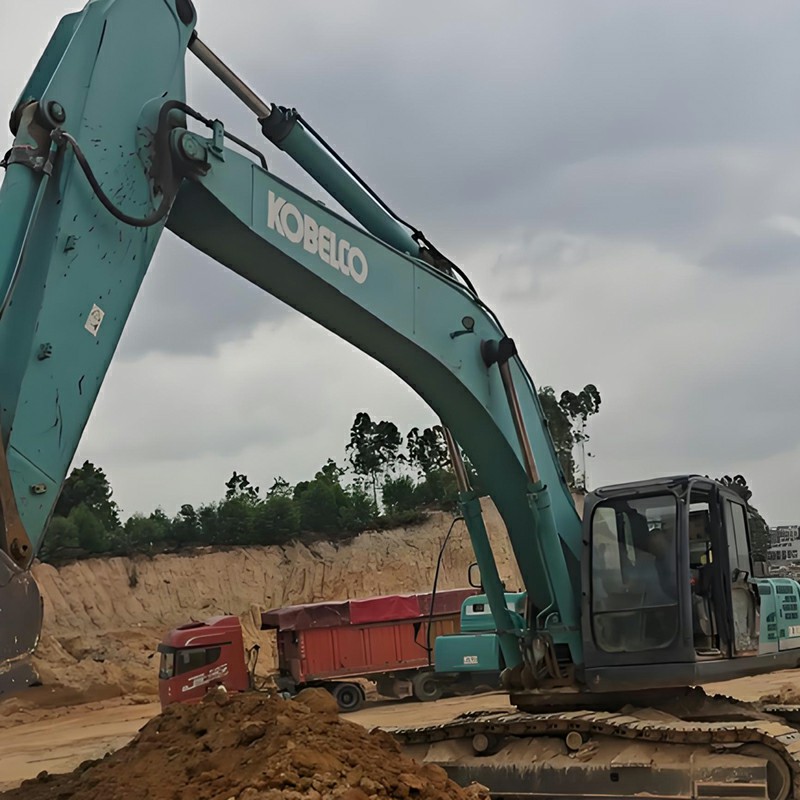
The machine runs fine on its own. The problem starts the moment you ask it to work: pull a lever to full stroke in the mid or high rpm range and the engine speed drops — sometimes far enough that it dies. At low idle it stalls almost immediately.
This is an SK200-8 with the Hino J05E engine, and there is no fault code stored and nothing in the history. The most telling detail: it happened most reliably at auto idle, the first time a lever was pulled to full stroke — boom up, arm in, or both travel levers together.
What was ruled out first
Fuel quality. No water in the tank or in the water separator, and the fuel was checked by specific gravity to confirm it was actually diesel. Ruled out properly rather than assumed.
Fault codes. Self-diagnosis showed nothing; the fault history was empty. That is normal for a mechanical failure inside the fuel system — the ECU only reports what its circuits can see, which is why "engine stalls under load, no code" is so often misdiagnosed.
The first clue: the controller was cutting power, not failing
On the monitor's diagnostic screen — NO.31, the boom screen — the last line is the torque-reduction current. At idle on a healthy machine it sits at 0 mA. On this machine it climbed as the symptom appeared:
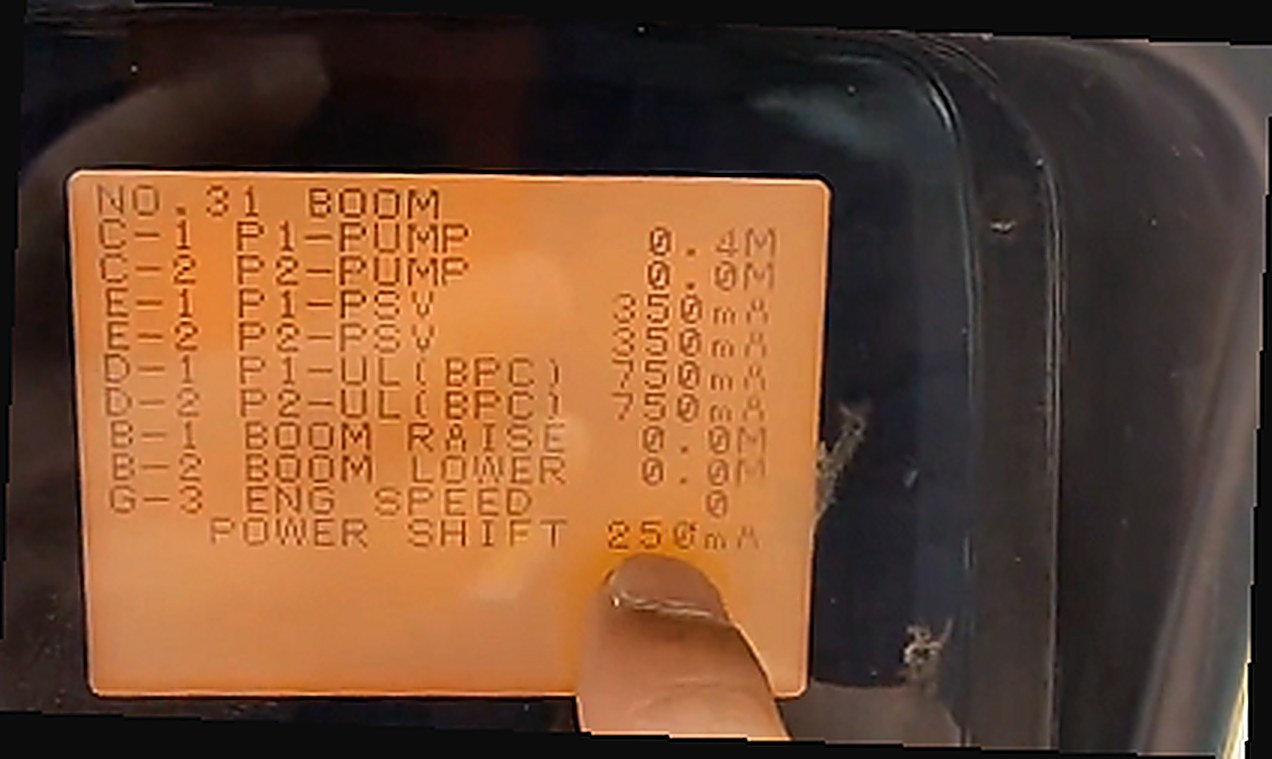
| Condition | Torque-reduction current |
|---|---|
| Engine running normally | 0 mA |
| Engine speed dropping | 80 – 150 mA |
| Engine stalled | 150 mA (maximum) |
| After recovering | Back to 0 mA |
That table is the machine telling you something important: the ECU was not the problem — it was reacting. When rail pressure falls, the controller commands the pump to absorb less power so the engine can recover. The rising current is the protection working. Chasing the controller is chasing the symptom.
Two different things are called torque reduction
This is where a lot of time gets lost, especially on a used machine. The figure above is the live current — what the controller is doing at that moment. There is a second figure in the monitor's adjustment screens: an adjustment value, a stored number that shifts the whole torque-reduction curve.
The two are not interchangeable, and a machine with an unknown history can be wrong in either:
Adjusted too aggressive — the controller cuts power harder than factory at the same load. The machine lugs and can stall exactly like a failing SCV, and no amount of valve replacement will change it.
Adjusted too light — the opposite: a slow machine with high fuel consumption, which the owner then tries to fix by looking for a mechanical fault that is not there.
Before condemning a valve on a machine you did not buy new, put the adjustment values back against the factory settings. It costs nothing and it removes a whole branch of the diagnosis.
P1 and P2 pump pressure went the wrong way
P1 and P2 are the two hydraulic pumps on the machine. The proportional valve on each pump has its own secondary pressure, measured separately.
With both pumps under a full-stroke operation:
Observed: the secondary pressure at the P1 pump and at the P2 pump both fell from 1.3 MPa to 0.8 MPa.
Expected: neither should fall. Under load they should rise to about 3.5 MPa.
That is the difference between "the pumps are being asked to work" and "the pumps cannot deliver". A healthy machine ramps pressure up when you pull a lever; this one lost pressure exactly when demand went up.
What did not fix it
The controller was swapped to rule it out. The symptom did not change. Fault diagnosis mode showed nothing abnormal. At this point the evidence pointed away from electronics and toward fuel delivery — but the machine still had no code to confirm it.
The confirmation
A Hino diagnostic tool finally showed what the machine's own monitor could not: rail pressure was dropping as the engine lost speed. Wiring was checked and found good. With the electrical side eliminated, the suction control valve on the high-pressure pump was the last item standing.
The SCV was replaced — on its own, without the pump — and the symptom disappeared.
Why an SCV causes a stall instead of a low-power complaint
The SCV meters fuel into the high-pressure pump. When it sticks or responds slowly, rail pressure falls as soon as the engine asks for more fuel. The ECU sees the shortfall and derates the pump to protect the engine, and the machine loses speed. If the demand is big enough — full lever stroke from auto idle — the drop takes the engine below idle and it stalls.
The same failed part can present as three different complaints depending on how far it has gone:
Low power under load — pressure falls but the engine keeps running.
Speed drops when operating — this case.
Will not rev at all — the valve is stuck far enough that pressure never builds.
The check order this case suggests
1. Rule out fuel quality. Water and wrong fuel produce similar symptoms and cost almost nothing to check.
2. Confirm the adjustment values are factory. On a machine of unknown history this comes before any part is replaced.
3. Read the torque-reduction current while reproducing the fault. Current climbing toward 150 mA means the ECU is derating — the machine is short of rail pressure, not short of electronics.
4. Measure P1 and P2 pump secondary pressure under load. Both should rise toward 3.5 MPa. Falling instead is the clearest single sign of a delivery problem.
5. Do not stop at the controller. Swapping the ECU is a common first move on a code-free machine. Here it changed nothing, and the hours spent on it did not move the diagnosis forward.
6. Confirm rail pressure with a diagnostic tool. The machine's own monitor does not always show what is happening to rail pressure during a transient.
Frequently asked
Why does my SK200-8 stall when I pull the lever at idle? The engine is already at the lowest speed it can hold, and any sudden hydraulic demand pulls it below idle. When the cause is fuel delivery — an SCV that cannot hold rail pressure — the derating that follows is enough to stop the engine.
Can a bad SCV cause a stall with no fault code? Yes. The SCV is a mechanical valve on the pump. A stuck spool produces no electrical fault, so nothing is stored. The only evidence is the rising torque-reduction current and falling rail pressure.
What is the difference between P1 and P2 pump pressure? They are the two separate hydraulic pumps, each with its own proportional valve and its own secondary pressure. They should read close to each other, and both should rise under load. If both fall together, the cause is usually shared — engine speed or fuel delivery — not a single pump.
Does the whole pump need replacing? Not necessarily. On this machine the SCV was replaced on its own. The workshop manual's procedure, if the valve is out of specification on resistance, is to remove the pump assembly and send it to an authorised Denso service centre — so confirm the pump condition before quoting.
Parts involved
The SCV on the high-pressure fuel pump is the part that fixed this machine: 294009-1221 / VH04226E0061 SCV valve for SK200-8 and SK210-8.
For the other way this same part fails — a machine that will not rev at all, with the monitor showing pressure rising while a gauge shows it is not — see the stuck SCV case on an SK200-8.
Note
Symptom, test values and part numbers come from one SK200-8 with the J05E engine. Rail pressure figures, torque-reduction values and adjustment settings differ between engine models and controller versions — confirm the specification for your machine before condemning a part.