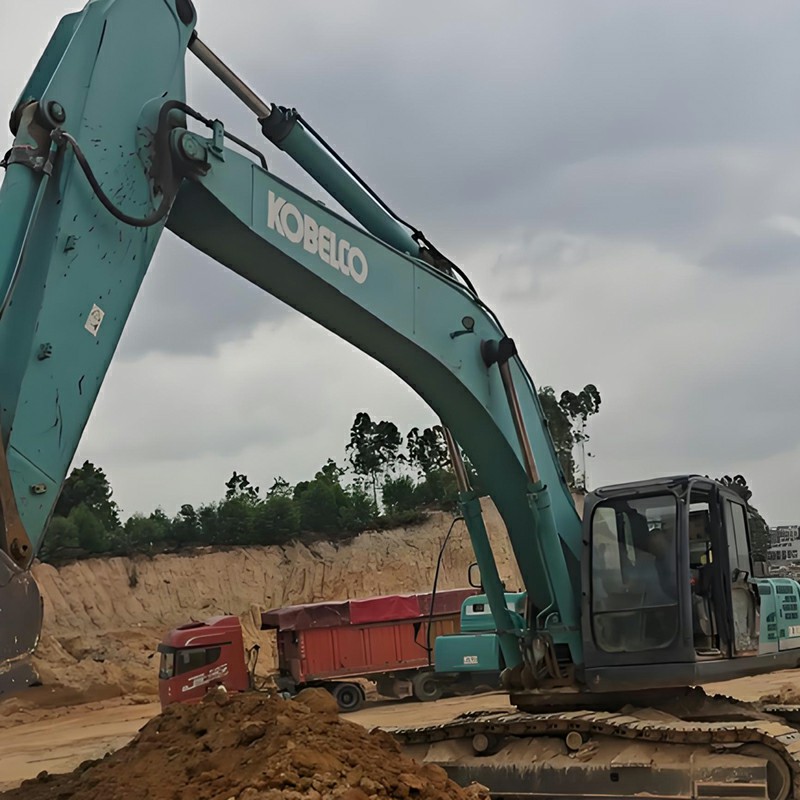
Boom up is slow on an SK200-10 or SK210-10, and nothing else is wrong. Not the whole machine — one function, one direction. That single detail is what makes this fault diagnosable: if only boom up is slow, the engine, the pilot circuit and both pumps are probably fine, and the problem is in the section that serves boom up specifically.
Two real cases below, both from SK200-10 class machines. They look identical from the seat and are completely different underneath.
The first measurement: P1 and P2 separately
Before either case applies, measure both pump pressures under load. Not one gauge on the system — one reading per pump, taken while the function is operated.
On these machines the main relief is around 34.3 MPa, so a pump reading roughly half of that under full load is not "a bit low" — it is not delivering.
Both pumps low: the fault is common to the machine — engine speed, pilot pressure, or a setting. Not this article.
One pump low, the other normal: the fault is in that pump's control side. This is where both cases below start.
[ Insert image here — a photo of both gauges connected, or the 8-bank solenoid group ]
P1 and P2 have to be measured separately. One gauge on the system tells you the machine is weak; two gauges tell you which pump is not delivering.
Case 1: P2 low, P1 normal
What was measured: with boom up operated, P1 sat at normal pressure and P2 would not go above about 15.5 MPa.
Half pressure on one pump, with the other healthy, means the pump is being told not to deliver. On the P2 side that command comes from the proportional valve that controls the pump's displacement.
What was found: the boom-up proportional valve on the 8-bank solenoid group was sticking. The coil was fine — the valve was not moving freely, so the controller's command never reached the pump.
Why it shows up as slow boom up and not a dead function: the pump still delivers something. The machine lifts, just badly. A completely stuck valve gives no movement at all; a partly stuck one gives you this — half pressure, slow function.
What to check:
a. Current at the valve. Read the command current on the monitor for that function. If the controller is commanding and the valve is not responding, the valve is the suspect, not the wiring.
b. Coil resistance. Compare the suspect coil with a known-good one on the same bank. A coil that reads very different from its neighbours is suspect; a coil that reads the same but does not move means the spool is stuck mechanically.
c. Swap test. If two valves on the bank share a type, swap the connectors and see whether the fault follows the valve. This is the fastest way to separate coil from spool without buying anything.
Case 2: P1 pressure cut off entirely
What was measured: with boom up operated, P1 did not just read low — it was being cut off. The pump was capable, but its oil was not reaching the boom circuit.
What was found: the 3-bank boom cut-off solenoid or the boom logic valve was stuck. The cut-off exists so the machine can prioritise flow elsewhere; when it sticks closed, boom up loses its supply while every other function behaves normally.
Why this one is easy to misdiagnose: pressure at the pump looks like a pump fault. Technicians replace pumps for this. The pump was fine — its output was being blocked downstream.
What to check:
a. Does the cut-off solenoid change state? Watch or listen while boom up is operated. No change means the signal is not arriving, or the valve is stuck in the cut position.
b. Feel the logic valve. With the engine off, remove and inspect the valve for a spool that does not return freely. Contamination here is common and shows as a valve that sticks only when warm.
c. Compare with another function that uses the same supply. If a different function on the same pump works normally, the pump is proven good and the block is in the boom section.
Telling the two cases apart
| Reading under boom up | Case | Suspect |
|---|---|---|
| P2 around 15.5 MPa, P1 normal | 1 | Boom proportional valve sticking, 8-bank group |
| P1 cut off, other P1 functions normal | 2 | Boom cut-off solenoid or logic valve stuck |
| Both pumps low | Neither | Engine speed, pilot pressure or a setting |
| Both pumps normal, boom still slow | Neither | Look at the cylinder, the spool or the relief in the boom section |
The distinction matters because the two repairs have nothing in common. Case 1 is a valve on the pump control side; case 2 is a valve in the boom circuit. Fitting the wrong one costs a part and changes nothing.
Before you order anything
Confirm the function is the only one affected. Boom up slow with arm also slow is a different fault — that points at supply, not at the boom section.
Confirm the pressure reading is repeatable. A gauge that reads 15.5 MPa once and 25 MPa the next time is telling you the valve is intermittent, which is still a valve — but it also means a single reading is not proof.
Check the pilot pressure for that function. A boom-up pilot pressure that is low will make the valve never fully shift, and it looks exactly like a sticking valve. Measure it at the pilot line before condemning the solenoid.
Solenoid valves for the 8 series and 10 series: excavator electrical parts — send the machine model and serial and we will confirm which coil is fitted, because the banks differ between build years.
Frequently asked
Boom up is slow but boom down is normal — is that hydraulic or electrical? It points at the boom-up side of the circuit specifically: the proportional valve or the cut-off that serves that direction. A pump fault would affect both directions.
Can a stuck valve fix itself? A valve that sticks only when hot will often free itself when the oil cools. That is not a repair — it will come back, and it usually gets worse. Treat it as a failing valve from the first occurrence.
Do I have to replace the whole solenoid group? No. The valve that is sticking is replaceable individually. Confirm which position it is, then replace that coil or that valve — not the bank.
Could it be the boom cylinder instead? A worn cylinder seal shows as drift or as weakness, not as a pump pressure that stops at 15.5 MPa. If the pressure is low, the fault is upstream of the cylinder.
Parts in this article
| Item | Where it is |
|---|---|
| Boom proportional valve | 8-bank solenoid group |
| Boom cut-off solenoid | 3-bank group |
| Boom logic valve | Boom circuit, at the cut-off |
For the pressure-side checks that apply to the whole machine rather than one function, see the SK200-8 that lost engine speed under load — same principle of reading the controller's reaction before replacing parts.
Note
Pressures and valve positions described above come from SK200-10 and SK210-10 machines. Solenoid bank layout and relief settings differ between build years — confirm against the serial number before ordering a valve.