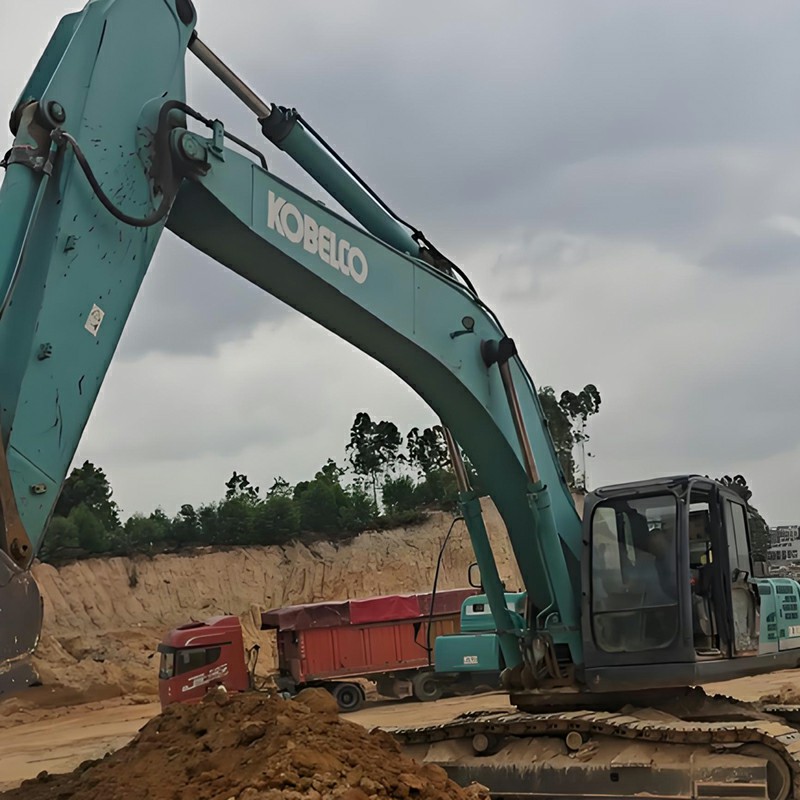
The bucket cylinder moves, but slowly. Not dead — slow, sometimes weak, sometimes jerky. On a Kobelco that narrows the fault to three places: the pressure signal the controller is reading, the solenoid that switches the circuit to high flow, or the valve spool itself.
Each one gets cheaper to rule out as you go down the list, so work in this order. Every check below happens with the machine off or at idle, no dismantling beyond a valve cover.
Step 1: read the pressure signal on the monitor
Before touching the hydraulics, confirm the controller is seeing the truth. If a pressure sensor is lying, the controller limits flow for a reason that does not exist — and every mechanical part you check afterwards is a waste of time.
Getting into the service menu: hold the buzzer stop switch and turn the key to ON. The diagnostic screens appear on the monitor; navigate to page 6 and read C-2 PUMP 2.

What it should read: with the engine off, pump pressure should sit near zero.
What a fault looks like: if the screen shows roughly 5.0–8.0 MPa with the engine off, nothing is generating that pressure — the sensor is reporting an offset. A sensor with an offset makes the controller believe the pump is already loaded, and it reduces flow to protect the engine. That is the slow bucket cylinder.
Confirm it before ordering: the same reading should be steady and repeatable. A sensor that jumps around is a different failure — usually wiring or the connector, not the sensor body.
If this reading is wrong, replace the high-pressure sensor — Kobelco high-pressure sensor for SK200-8 — and re-check the cylinder before going further.
Step 2: check the arm 2-speed solenoid current
If the pressure reading is normal, the next suspect is the solenoid that shifts the circuit into high flow. The bucket and arm circuit runs in two speeds: a low-flow mode for fine control and a high-flow mode for fast movement. If the solenoid never switches, the machine keeps working — just slowly.
Where to look: monitor page 7, the line labelled D-6 ARM IN 2-SPEED. That is the current the controller is sending to the solenoid.

How to read it: pull the lever to full stroke and watch the number. It should change as the circuit switches. A current that never moves — or reads zero — means the controller is not commanding the solenoid, or the solenoid circuit is open.
What to do next: if the current does not change, measure at the solenoid connector to separate the two: no supply voltage means the wiring or the controller output; supply present but no movement means the coil or the valve.

If the solenoid has to be replaced, use the correct series for the machine: 40C50 series solenoid valve. Fitting a valve from the wrong series changes the flow characteristics, and the cylinder will still feel wrong even though it moves.
Step 3: inspect the valve spool
Both electrical checks can pass and the cylinder can still be slow, because the spool that directs the oil may not be moving freely. Contamination — a chip, a piece of seal, sludge from old oil — scores the bore or jams the spool part-way, and flow is restricted mechanically.
How to check: remove the valve cover and pull the spool. Look for scoring along the lands, a bright wear band, or a spool that does not slide freely by hand. A spool that sticks in one spot when you slide it by hand is a mechanical fault, no meter required.

If the bore is scored, cleaning the spool is not a repair. Replace the valve section, and find out where the contamination came from — otherwise the new one will do the same thing.
Which check to do first
| Order | Check | What it tells you |
|---|---|---|
| 1 | Page 6, C-2 PUMP 2 | Whether the controller is being fed false pressure data |
| 2 | Page 7, D-6 ARM IN 2-SPEED | Whether high flow is being commanded at all |
| 3 | Spool inspection | Whether oil can physically reach the cylinder |
Doing it in this order matters because the three faults produce an identical symptom. A sensor offset, a dead solenoid and a scored spool all leave you with a cylinder that moves too slowly — and only one of them is fixed by buying a part.
Frequently asked
The bucket cylinder is slow but the arm is fine — is it still the 2-speed circuit? Not necessarily. A single-function problem points more at that function's spool or its relief than at the shared 2-speed valve. Check whether the slowdown is one function or several before ordering anything.
Can I just replace the sensor without checking the monitor? You can, but you are guessing. The reading takes two minutes and costs nothing; if it comes back normal you have saved the price of a sensor and moved to the correct cause.
Does slow always mean a worn cylinder? No. A worn cylinder seal usually shows up as drift or as weakness under load, not as consistently slow movement. Slow movement with normal force is a flow problem — sensor, solenoid or spool.
Parts in this article
| Item | Part |
|---|---|
| High-pressure sensor | YN52S00103P1 |
| Arm 2-speed solenoid | 40C50 series, YN35V00049F1 |
For a code-free hydraulic fault like this, the other article worth reading is the SK200-8 that would not rev at all — same principle, different circuit: the machine was being derated by the controller because a pressure signal was wrong.
Note
Monitor page numbers and the 5.0–8.0 MPa threshold in this article apply to the SK200-8. Other models and controller versions put the same data on different pages — confirm the layout for your machine before relying on a page number.